Beware of Egg-Nog: An 1817 Warning

I am not claiming that egg-nog originated in New Hampshire.  It probably was first made in ye olde England as a mixture of Spanish “Sherry” and milk.

Though our weather is outlandishly warm, there are a few who have the holidays on their mind. (I myself am waiting for the inevitable “cold snap” to get into the mood).

The New England colonists preferred rum to sherry. In colonial America, rum was commonly called “grog“, so the name eggnog is likely derived from the very descriptive term for this drink, “egg-and-grog”, which corrupted to egg’n’grog and soon to eggnog.

Our first President, George Washington, was quite a fan of eggnog and he concocted his own recipe. His version included one quart of cream, one quart of milk, a dozen eggs, one pint of brandy, a half pint of rye (whiskey), a quarter pint of rum, and a quarter pint of sherry. WOW! I bet this made the Washington homestead popular during the holidays.

An 1815 article in the Newburyport Herald reports that eggnog “is a liquor with which the Americans used to treat their friends on Christmas Day.” (so apparently it was already a tradition in the United States by this time).  Several old New Hampshire newspaper articles indicate that egg-nog was served “hot.”

There are countless recipes for eggnog, but I think some of the most interesting can be found here.  Do you have a favorite eggnog recipe?

Not everyone promoted the benefits of eggnog, and some even thought it is the work of the devil? Really 😀

Janice

The poem below if from the The American Beacon, Norfolk, December 24, 1817 [and reprinted in New Hampshire newspapers during the same year]
A Song of the Season, To be sung to any tune that suits the measure.

–BEWARE OF EGG-NOG–
While the little boys cry ‘merry Christmas is coming,’
Shall I be as dull as a water-drunk log?
No! I’ll sing you a song (for we bards must be humming)
And the burden shall still be, Beware of Egg-nog.

When the bowl mantles over the elegant foam,
And the steam rises up in a silvery tog;
Put by the potation, keep Reason at home,
And think of my warning, Beware of Egg-nog.

When Circe, the witch, caught Ulysses’s men,
She gave each a dram that soon made him a hog;
The identical mixture–’tis now as ’twas then;
So attend to the moral, Beware of Egg-nog.

When the circle is form’d, the glass passes round,
Old Satan draws night, tho’, as usual, incog.,
And chuckles to see good Sobriety drown’d–
Would you frustrate his malice–Beware of Egg-nog.

But why do I rail at one liquor this way?
Is no other as fatal; rum, brandy, or grog?
Yes, yes, they’re all one, I mean all when I say,
And I’ll say but once more now, Beware of Egg-nog.
—–


Posted in Holidays, Humor, Not New Hampshire | Tagged , , , , , | Leave a comment

New Hampshire Glossary: Blaze

blaze– this word is American in origin.  It means, a mark, usually on a tree, designed to indicate the direction of a trail.

In early days of New Hampshire, marked trees were often the only indication used to locate an area, or newly defined town.  In the colonial days of New Hampshire, these marked trees were often the only method for people to find their way through the wilderness.  The blaze, or mark, was often as simple as a single hatchet chop or several of them.

Today trail blazing still occurs, mostly in outdoor recreational areas, and may include paint, affixed (such as tape), flag markers and cairns (piles of stones).

Janice

–Trail Blazing–

Posted in New Hampshire Glossary | Tagged , , , , , , , | Leave a comment

Dublin New Hampshire publisher, Robb Hansell Sagendorph (1900-1970)

A New Hampshire tradition was born in 1935–Yankee magazine.

“Climb up on some hill at sunrise. Everybody needs perspective once in a while, and you’ll find it there.”  Robb Sagendorph could have as easily been talking about Yankee Magazine itself.  Along with his artist director wife, Beatrix (Thorne) Sagendorph, Robb began publishing Yankee, the magazine that reflected New Hampshire, and New England life, in its most memorable and pristine forms.

Robb was publisher, president and director of the magazine “Yankee” until  1970. In 1939 he had bought the rights to the “Old Farmer’s Almanac” from Little Brown and Company and returned it to its original look from 1792. In 1935 he became president and director of Yankee, Inc.

Rob Sagendorph

Rob Sagendorph

Robert Hansell Sagendorph, but called “Robb,” he was born in Newton Centre, Massachusetts to George Adam & Jane Cooper (Hansell) Sagendorph. He had three sisters, Marian, Joan and Elizabeth. His father was the owner of an iron manufacturing company. He grew up in Massachusetts, attending Newton and Brookline MA public schools, Noble and Greenough, and Harvard College.  In addition to his involvement with Yankee Inc., he was a director of Penn Metal Co., selectman and moderator of the Town of Dublin.  He was a member of Harvard Club of New York and of the Brookline (MA) Country Club.

He married Beatrix Thorne, daughter of George and Louise Thorne. She was born 7 April 1900 in Evanston IL.   He died on 4 July 1970 in Dublin, New Hampshire. Beatrix died April 1985.

Robb’s sister Marion Bradford Sagendorph, was born 1 March 1903 in Newton MA and died 29 Oct 1991.  She married 25 June 1923 in Newton MA to Roger D. Hale.  He was b. 2 Sep 1900 in Newton MA, son of Frank Judson & Grace Elona (Herrick) Hale. Besides their son Judson [see more below], they had children Roger D. and Patricia Hale.

Beatrice (Thorne) Sagendorph was an artist of original paintings that found their way to the cover of Yankee” magazine, many of them outdoor scenes. For a number of years she taught art classes for children in an elementary public school in New Hampshire. She was a member of the New Hampshire Art Association, on the board of directors of the Copley Society of Boston, a member of the International Council of the Museum of Modern Art and of the Cosmpolitan Club of New York.  In 1965 she donated the Thorne Art Gallery to Keene State College in memory of her mother, Mrs. George A. Thorne of Chicago and Dublin New Hampshire.   Mrs. Sagendorph held several one-man shows and has exhibited in a variety of exhibitions and jury shows. In the spring of 1968 she won honorable mention in the Fitchburg Museum Show, for an abstract.

Robb and Beatrix’s children included:
1. Lorna Sagendorph, born 13 Sep 1933 and died 19 March 2004. She married C. Robertson Trowbridge. At one time he was publisher of Yankee magazine, he was born 31 March 1932, and died 10 Sept 2003.  They had divorced.  Their children were Jamie Trowbridge, Cor Trowbridge, Beatrix (Trowbridge) Sanders and Phil Trowbridge. Jamie Trowbridge is currently President of Yankee Publishing Incorporated.
2. Jane/Jayne Thorne (Sagendorph) Germond,  a professional artist whose paintings appeared from time to time on the older covers of Yankee.  She silk-screened as well as authored two children’s books, “What Happened to George” and “Hansell, the Tasselman.” She held shows in Alberqueque NM, Sharon NH as well as exhibiting with the New Hampshire Art Association traveling exhibit, and with the Currier Gallery, Manchester.  She has participated in the Fall River Art Association (national exhibit) and the Providence Art Club group shows. Her works have won awards. Included in her Strawbery Banke exhibit is a recent portrait of May Sarton, the distinguished poet and novelist, who has made her home in the New Hampshire Monadnock region the past 10 years.  Mrs. Germond is the wife of Russell Germond, who is a professor at the Rhode Island School of Design. The couple have a son and two daughters, and resided in Providence Rhode Island.

Now Robb’s nephew, Judson D. “Jud” Hale Sr. is the editor in chief and the chairman of the board of directors. Jud came to the magazine as a young man in 1958 “to get some experience.”  A Boston native, Jud was raised in rural Maine (Vanceboro) and has degrees from the Choate School and Dartmouth College (Class of 1955). He lives with his wife Sally (Huberlie) on a 26-acre spread with view of Mt. Monadnock. They have three married sons, Judson Jr. (aka JD, who is publisher of Yankee magazine), Daniel and Christopher, and seven grandchildren.

Judson Sr. is one of the largest shareholders in the “still-family-owned,” Yankee Publishing. In a recent interview he said with mock solemnity, “In the next century, our aim is to own New England — metaphorically speaking.”

Janice

*Additional Reading*

–Thorne-Sagendorph Gallery, Keene State College–

–Paintings of Robb and Beatrix Sagendorph–

–Yankee Magazine Editors–

-Jud’s New England Journal-

[updated January 2014]

Posted in New Hampshire Men, New Hampshire Women | Tagged , , , , , , , , , , , , , , | 1 Comment

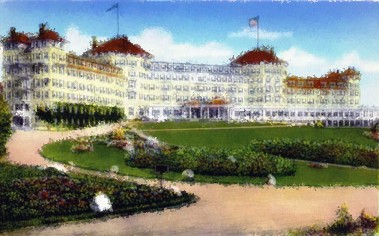
Mt. Washington Hotel at Bretton Woods

Posted in History | Tagged , , , , , | Leave a comment

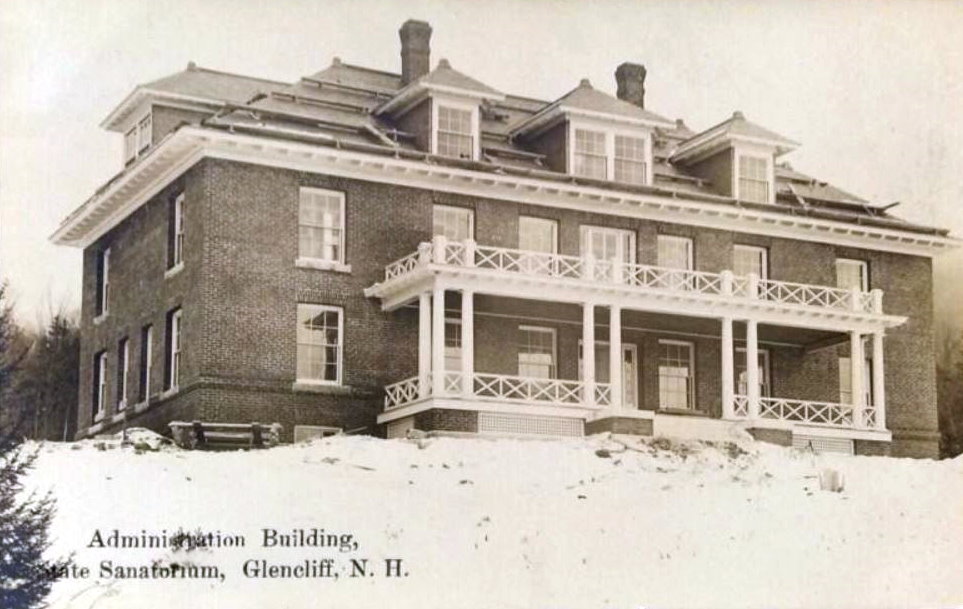
Missing Places: New Hampshire State Sanitorium at Glencliff

Sanitorium at Glencliff, New Hampshire

Sanitorium at Glencliff, New Hampshire

I remember as a child, a road trip through Glencliff New Hampshire, with my parents, on our way to the White Mountains. We weren’t on one of the major highways, of course.  My father preferred taking short-cuts (which were really scenic long-cuts) whenever possible. He pointed out a building to us, stating that his sister had been a patient there, when it was the New Hampshire State Sanitorium.  She had died of tuberculosis as a young woman.glencliff2

Nicknamed “The San,” by local residents, the New Hampshire State Sanitorium construction was approved in 1901 by the state legislature. That same year New Hampshire’s annual death rate from tuberculosis was 194 per 100,000 people, and it was the most common cause of death for people between the ages of 20 and 40.

It was created at the recommendation of a 1901 NH legislature-authorized commission made up of Dr. Ezra Mitchell of Lancaster, Dr. Nathaniel G. Brooks of Charlestown and Dr. Irving A. Watson of Concord, who was also secretary of the board of health. They presented their recommendations in 1902. Five years later this “Sanatorium for Consumptives,” was established by the New Hampshire legislature in 1907, built on 411 acres of land on the southern slope of Mount Moosilauke, and opened in 1909. It consisted of two wards, one for men and one for women. In 1912 the building was enlarged and a service building added to the facility. In 1913 and 1914 a barn, a piggery, refrigerating plant, coal pocket and shack were added. At that time the NH State Sanatorium had a capacity of sixty-four patients. Superintendents of the sanitarium included: P. Challis Bartlett of Rutland MA (1909-10), John E. Runnels of Lakeville MA (1910-1912) and John M. Wise of Rutland MA (in 1912).

The sanatorium was located here, based on the belief that continued exposure to fresh cold air, and rest, was essential to recovery from tuberculosis (aka T.B.).  Patients at Glencliff slept year-round on open-air porches.  More than 4,000 people were treated there up until it closed.  Most of the patients came from major cities in southern New Hampshire.  Any resident of the state having active tuberculosis were considered for admission, regardless of their ability to pay.  Children under the age of 14 with tuberculosis were treated instead at the Pembroke Sanitarium.

In 1970, the Glencliff Sanatorium was converted into the Glencliff Home for the Elderly. Today Glencliff Home for the Elderly is a 106-bed nursing home facility that provides care for mentally ill or developmentally disabled elderly adults.  GHE is part of the community mental health centers to provide nursing home level care for NH’s elderly in need of specialized psychiatric care.

For those of you researching the records of this location, the New Hampshire State Library has annual reports for the state sanatorium in Glencliff for 1908 to 1947, as well as annual reports for the Pembroke Sanatorium for 1912 and 1914, and a booklet from the White Mountain Tuberculosis Sanatorium. (These records do not include names.)

A bit of Tuberculosis Trivia…
–Tuberculosis bacteria are airborne and stay in the air four hours after a TB-infected person leaves the room.

–The American Lung Association of New Hampshire, is the state’s oldest nonprofit voluntary health agency.  It was established in 1916 as the New Hampshire Tuberculosis Association, to help prevent the spread of that disease. As antibiotics were invented to bring the spread of tuberculosis under control, this agency evolved into the association we know today, and focusing on lung disease prevention and advocacy.

–Tuberculosis has not been completely eradicated.  In New Hampshire the annual incidence of tuberculosis in New Hampshire, although small, is 1.6 people per 100,000 population.  Most diagnosed cases will recover after six months of treatment with antibiotics. A total of 14,093 TB cases were reported in the United States in 2005, down from 14,516 cases in 2004.  The 2005 national TB case rate – 4.8 cases per 100,000 persons – was the lowest since reporting began in 1953.  However, the decline of 3.8 percent in the national TB case rate from 2004 to 2005 was one of the smallest declines in more than a decade.

–Is the possibility of a virtually un-treatable TB on the horizon? An extremely virulent, drug-resistant (therefore lethal) form of tuberculosis has been identified. It killed 52 out of 53 people at a hospital in KawZulu-Natal in South Africa. Called XDR Tb, there are 347 cases worldwide, including some in the United States. Life expectancy is 16 days to a month after infection.

Janice

*Additional Reading*

–Story of Glencliff–

–CDC Notes for Tuberculosis (in NH)-

P.S. Please note the word sanitorium is sometimes spelled sanatorium.  Both spellings are considered correct.

Posted in N.H. Missing Places | Tagged , , , , , , , , , | 8 Comments