New Hampshire Glossary: Niddy Noddy

Two hundred years ago, every self-respecting New Hampshire woman

used a niddy-noddy, or at the very least she knew what it was.

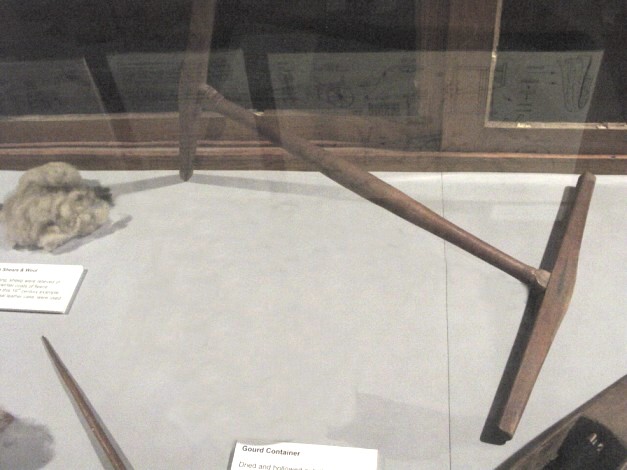
Niddy-noddy – a wooden device used while hand-spinning to measure the length of newly spun thread or yarn.  One full winding around the niddy-noddy equaled two yards.


While using this device, to keep track of the length, this rhyme was often recited:
Niddy-noddy, niddy-noddy,
Two heads, one body,
‘Tis one, ‘taint one,
‘Twill be one, bye and bye.
‘Tis two, ‘taint two,
‘Twill be two, bye and bye
.

According to folklore, “niddy” comes from a nickname for grandmother, who would often spend a lot of time knitting.  “Noddy” may refer to how the grandmother would often “nod off” (or fall asleep) while thus occupied. More probably the term “noddy” comes from the way the tool moved when used–the person winding the yarn would dip or nod the cross bars with an elbow-wrist movement.

Janice

Further Reading

– New Hampshire Glossary –
– As the Yarn Turns: How to Construct a Niddy Noddy [using PVC]-
Interactive Activity: Niddy-Noddy – [movie shows how a Niddy Noddy is used]
– What does a Niddy Noddy Do? –
Using a Niddy-noddy –
Making A Skein with a Niddy-Noddy

Posted in New Hampshire Glossary | Tagged , , , , , | Leave a comment

Niddy Noddy

Posted in History | Tagged , , , , | Leave a comment

New Ipswich New Hampshire Artist: Benjamin Champney (1817-1907)

Benjamin Champney, from Sixty Years' Memoris of Art and Artists, by Benjamin Champney, frontispiece. 1899

Benjamin Champney, from Sixty Years’ Memoris of Art and Artists, by Benjamin Champney, frontispiece. 1899

Lithographer and renowned landscape, portrait and floral painter, Benjamin Champney,  was born in New Ipswich New Hampshire, 17 Nov 1817.

He began his career as a lithographer in Boston, but became a renowned landscape, portrait and floral painter. He was especially associated with scenes of the White Mountains of New Hampshire and described by one art historian as the “dean of the White Mountain painters” (Falk). He is considered the founder of the “White Mountain School” of painters who came to North Conway and surrounding areas during the second half of the nineteenth century.  He died in Woburn, MA in 1907. Continue reading

Posted in Genealogy, New Hampshire Men | Tagged , , , , , , , , | 19 Comments

Benjamin Crackbone Champney (1817-1907)

Posted in History | Tagged , | Leave a comment

New Hampshire’s Mooooo-la-la

The premier source in New Hampshire for everything moootivating, at least in the bovine world has to be the Stonyfield Farm web site.

With web topics entitled, “What’s Moo [New],” “Have-A-Cow” (where you can actually sponsor a real dairy cow), “Celebrities in the Moos,” and a daily blog called “The Bovine Bugle,” I found myself “moooved” beyond my wildest expectations.

Burning questions such as “What the heck is a Pole Barn,” and “what is ketosis and drenching.” are questions posed by members of this online com”moo”nity to a real life farmer, who responds with practical answers.

If you worry about eating like a pig without looking like a cow [as Joanie does], did you know that eating yogurt actually helps you to lose weight? Eating yogurt may actually help turn up the body’s fat-burning ability.

Stonyfield Yogurt Inc. itself was “born and raisedin New Hampshire.  The venture began in 1978 in Wilton, New Hampshire, as Samuel and Louise Kaymen’s “Rural Education Center,” an organic farming school. In 1982 current President/CEO Gary Hirshberg was recruited as a board member. In 1983 they had seven dairy cows and a newly created yogurt recipe. In 1989 the company moved to Londonderry, New Hampshire where it is located today, selling its products of yogurt, yogurt smoothies, cultured soy, organic ice cream, frozen yogurt and milk nationwide, with annual sales of over $212 million (thats alot of moola). They donate 10% of pretax profits to environmental causes.

If only everyone could be as earth-centered!

If you get a chance, take a tour of this fascinating company. According to their web site Stonyfield tours have been temporarily suspected due to heavy construction going on (yes, they are growing again). 
Janice

PS: If you are wondering about the origin of the word “moola,” I have a pretty good theory.  The Gaelic word for million is “muillean,” pronounced “Moo-lin.”  Close enough.

Additional Reading
History of Yogurt in the United States
Things I Can’t Live Without: Gary Hirshberg
History of Stonyfield


Posted in Cow Stories, Current Events, Travel | Tagged , , , , , | Leave a comment