
North Barnstead New Hampshire’s Harriet P. Dame: the "Florence Nightingale" of The Civil War (1815-1900)

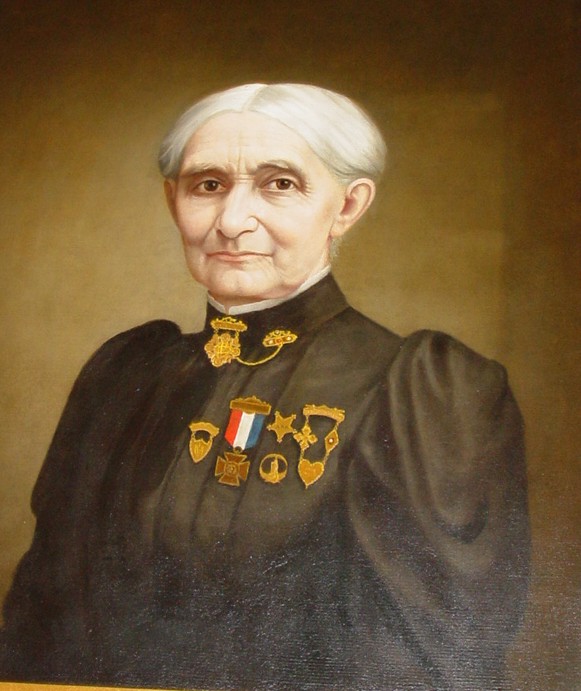
Harriet Patience Dame, painting hanging in the NH State House. Photograph taken in 2004 by Janice W. Brown.

Harriet Patience Dame, painting hanging in the NH State House. Photograph taken in 2004 by Janice W. Brown.

Harriet Patience Dame, daughter of James Chadbourne and Phebe (Ayers) Dame, was born at North Barnstead, New Hampshire on 5 January 1815, and died 24 April 1900. She became an army nurse, and joined the Second Regiment N.H. Volunteers, as hospital matron in June 1861.

She was mustered out in December 1865–after four years and eight months of service. She “endured all the privations of the troops, marched and camped with them, being oftentimes the only woman among a thousand men. She has nursed her ‘boys’ through small-pox, she has worked all night on the field caring for the wounded, and she has buried the dead.” Continue reading

Posted in Military of New Hampshire, New Hampshire Women | Tagged , , , , , , , , , , , , , , , , , , , , , , , , | 3 Comments

Paddy Whacking in New Hampshire

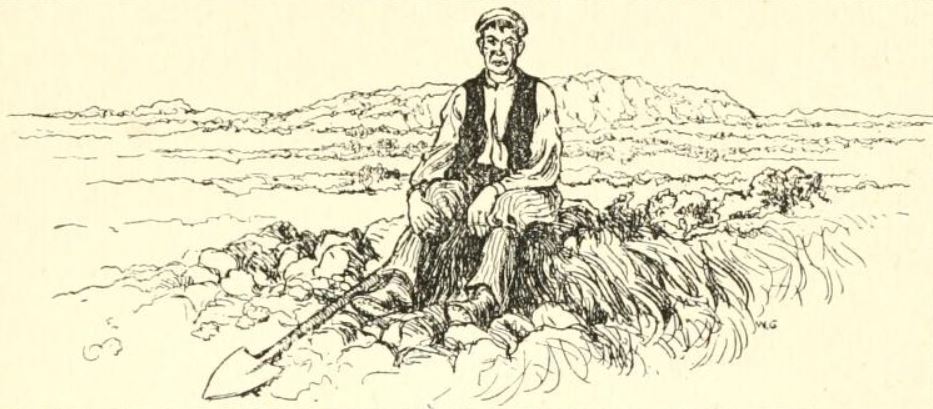
Sketch of an Irish man, from "Irish ways," by Jane Barlow; George Allen & Sons, (1909) from the University of California Libraries; on the Internet Archive.

Sketch of an Irish man, from “Irish ways,” by Jane Barlow; George Allen & Sons, (1909) from the University of California Libraries; from the  Internet Archive.

One of the myths of both New Hampshire, and American history, is that immigrants were warmly welcomed to our “land of opportunity.”  The only way for us not to repeat history’s mistakes, is to learn from them.  In order to learn from them, we need to gain a realistic view of the past.

The 1840s and 50s in New Hampshire were not good decades for Irish immigrants, nor Catholics in general. This sad part of New Hampshire’s history is now rarely mentioned.  Those who were participants in the original incidents have long passed away. Continue reading

Posted in Carnivals and Memes, History, Irish in New Hampshire | Leave a comment

New Hampshire Glossary: Tin Reflector Oven

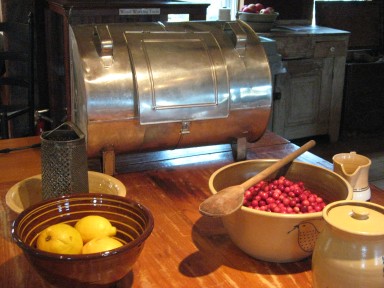
Tin reflector ovens were used to cook food in the late 18th century and early 19th century, in conjunction with a home’s fireplace.

This device, sometimes also made out of copper, was set on the hearth in front of the fire. The heat reflected its polished back, and would bake, roast or broil meat.

The Remick Museum in Tamworth New Hampshire uses such an oven to roast turkey as part of a historic menu for the general public.On Saturday, November 10, 2007 from 1-4 PM join the Remick Museum for good food, country crafts and a healthy dose of history.

The menu for Historic Thanksgiving includes roasted turkey, bread sauce stuffing-dressing, hearth bread and butter, boiled cider pie, Indian pudding, pumpkin stuffed with apples and cranberry sauce.  The event itself is free and open to the public; donations are gratefully accepted. The meal is $3.00 per plate. Try your hand at making apple cider, and in the English barn, make a corn cob feather dart.

The Remick Country Doctor Museum & Farm is located at 58 Cleveland Hill Road, Tamworth, NH. For more information call (800) 686-6117 or (603) 323-7591, or visit their website at www.remickmuseum.org.

Janice

Posted in Current Events, New Hampshire Glossary, Travel | Tagged , , , , , , , , , | Leave a comment

Tin Reflector Oven

Posted in History | Tagged , , , , , , , , , , , | Leave a comment

Salem New Hampshire’s Canobie Lake and Park

Canobie Lake is a beautiful sheet of water, situated partly in Windham and partly in Salem, New Hampshire, and within the limits of the original Scots-Irish settlement of Londonderry, New Hampshire.  Before the incorporation of Salem, the lake was earliest

known as “Haverhill Pond” and “Haverhill Bound Pond.”  By 1715 (as noted in various records) it began to be called Policy Pond.”

Local legends says it was named after a Mr. Poliss, or Polliss, who owned land bordering on it in colonial days By a second account it was named after a local chief of the Native People [Indians] whose surname was Polis. Both of these accounts are purely speculative. Perhaps the second one inadvertently refers to the fact that Henry David Thoreau mentions a Penobscot Indian, Joe Polis, in his book “The Maine Woods.” That Joe Polis would have lived too late in history to have this pond named after him, and his ancestors probably lived in Maine. Continue reading

Posted in Carnivals and Memes, History, Travel | Tagged , , , , , , , , , , , , , , , , , , , , , , , | Leave a comment