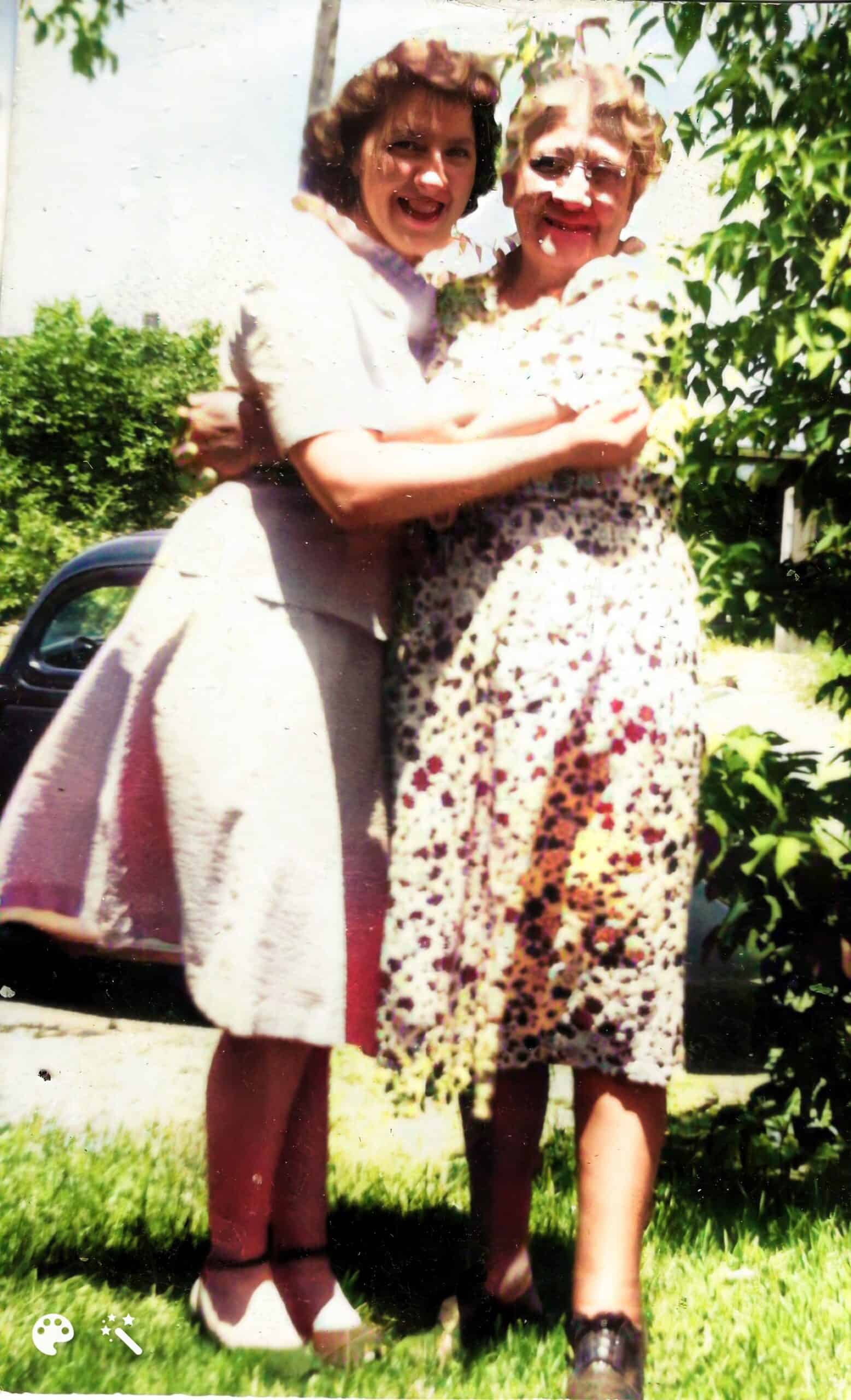
Mary Webster with her mother Addie. Rare photo of them together as my mom often was the photographer not the subject.
On Mother’s Day, mtDNA gets top billing—because it’s the one gift Mom passes down 100% every single time.
When people first step into the world of genealogy, they often imagine themselves wandering through dusty courthouses, squinting at old census pages, or chasing down rumors of a great‑grandmother who may or may not have existed. But there is another kind of record—one that doesn’t fade, burn, or get misfiled. It lives quietly inside every person, waiting to be read. And that record is mitochondrial DNA.
Most newcomers assume mtDNA belongs to women alone, simply because it travels down the maternal line. But the truth is far more democratic. Every person—man or woman—carries the exact mtDNA of their mother, who carried the exact mtDNA of her mother, and so on, in an unbroken chain stretching back through centuries of births, migrations, hardships, and triumphs. It is the one lineage that never gets lost in a courthouse fire, and never forgets where it came from.
For some genealogists, mtDNA becomes the key that unlocks a mystery no paper trail could solve. A man searching for the origins of his maternal grandmother may discover that his mtDNA matches descendants of a woman born in a tiny coastal village he never knew existed. A woman trying to confirm whether two sisters in an 1820s church record were truly related may find that their living descendants share the same rare haplogroup, proving a connection the documents only hinted at. In these moments, mtDNA becomes more than a scientific tool—it becomes a storyteller.
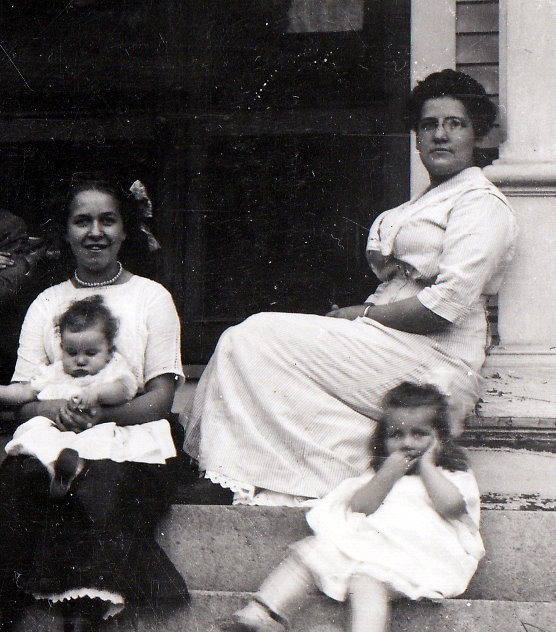
My grandmother (seated R) with her daughter Anna (bottom step) and son Berwin (the baby being held by unidentified woman).
What makes mtDNA so powerful is its steadiness. While autosomal DNA (like the test on Ancestry.com) scatters and dilutes with every generation, mtDNA holds its shape. It carries the echoes of ancient migrations, the signatures of maternal ancestors who crossed oceans or stayed rooted in the same valley for centuries. It can confirm relationships that autosomal DNA is too faint to detect, and it can connect distant cousins who would never appear on each other’s match lists otherwise.
And perhaps most importantly, mtDNA gives men and women equal access to the maternal past. A man may not pass his mtDNA on, but he carries it just as faithfully as his sister. His results are just as valid, just as revealing, just as essential to the shared work of reconstructing a maternal line. In collaborative spaces like WikiTree, where accuracy depends on many hands contributing many pieces, mtDNA becomes a communal anchor—one that helps genealogists build trees that are not only bigger, but truer.
In the end, mtDNA is not a niche test or a specialty tool. It is a quiet constant, a thread that refuses to break, a lineage that belongs to everyone. Whether you are a man searching for the story of your mother’s mother, or a woman tracing the deep roots of your maternal line, mtDNA offers a way to listen to the ancestors who rarely appear in records but who shaped every generation that followed.
mtDNA opens a doorway into the deep past in a way no other genetic test can, because it preserves a nearly unchanged record of your maternal line stretching back thousands of years. When you test your mtDNA, you’re not just learning about a single ancestor—you’re tapping into an ancient lineage that can reveal prehistoric movements, population histories, and the deep origins of your maternal haplogroup, allowing you to glimpse a story written long before written records existed.
 Even after you take an mtDNA test, the real work of understanding your closely related maternal line is just beginning, because a haplogroup alone can’t tell you which specific ancestor you share with others who carry the same one. mtDNA provides a deep genetic signature, but you still need to build out your maternal tree—mother to mother to mother—so you can compare your documented line with the earliest known maternal ancestors of your matches. Only by pairing the genetic evidence with careful genealogical research can you confirm where your more recent line intersects with others who share your haplogroup and begin to uncover the true story of your shared maternal past.
Wishing you a warm and meaningful Mother’s Day, and hoping it inspires you to honor your maternal line by taking an mtDNA test—there’s no better gift to yourself than discovering the story carried quietly through every mother who came before you.
Additional Reading:
Surprising Discoveries with mtDNA
New Hampshire Matrilineality and Mother’s Day
What is Mitochondrial DNA (mtDNA)? Explained Simply

David Greene was in the Civil War and the family was out of Derry, NH. I can send you a copy of the Civil War information. If you would like to add my family. We are a descendent of Dudley. I haven’t found anything about the Greene family in your information.