November Carnivals & Memes

The exciting first edition of Tim Abbott's “Carnival: Cabinet of Curiosities” was released yesterday.  Well, not exactly released–more like opening up Pandora's box.  It is strangely disturbing reading for those who enjoy the bizarre, the nostalgic, and the shrunken.

The next Cabinet of Curiosities will be the 17th of December at

Walking the Berkshires, and subsequent carnivals will appear on the

third Monday of the month… This way for the Egress!

******************************

The 36th Edition of the Carnival of Genealogy, is now posted on Creative Gene. Since this is a “carousel” edition, a park's 1903 antique carousel itself became the inspiration to write my article about Salem New Hampshire's Canobie Lake and Canobie Lake Park.  So gallop on over and read some intriguing submissions.  You might just catch a few bars of calliope music.

******************************

The 1st Edition of the Carnival of Irish Heritage and Culture, is now posted over at Small-leaved Shamrock. Lisa has done a wonderful job collecting and writing about the contributed articles.  The next edition entries must be received by December 28th, in order to be posted on January 1, 2008.  So if you have a story you'd like to share, don't delay!

******************************

I've been tagged… twice, err THREE times….

Becky Wiseman of kinexxions, Susan Kitchens at Family Oral History Using Digital Tools, and  Schelly Dardashti at Tracing the Tribe, have tagged me for the “161 Meme.” 

Instructions in order to participate are straightforward–open up a book I'm currently reading to page 161 and share the 6th sentence on that page in a blog article.  Then tag five more bloggers to do the same.

Let me be honest…I'm not currently reading a book. But a book I finished reading lately (a few weeks ago) was “The Widow's War,” by Sally Gunning.  I can't recall page 161, and the book has already been passed along to a friend.  However, the Amazon site lets me view a few of the book pages, and the closest I could come to page 161 was page 157.  The sixth sentence is: “He watched her.”

Set in pre-revolutionary America, the story revolves around Lyddie Berry whose husband is lost in a whaling disaster.  The challenges that she faces are harsher than what women face today (hopefully). This is an excellent novel that helps readers understand the socio-economic influences on women in colonial America.  If I have a criticism, it is that the character development, specifically of Sam Cowett, is very shallow.

As for tagging others…. if any of my readers has not yet been tagged for the “161 Meme” and would like to participate, please do!  Let me know and I'll post a link to your article here.

Janice

Posted in Carnivals and Memes | Leave a comment

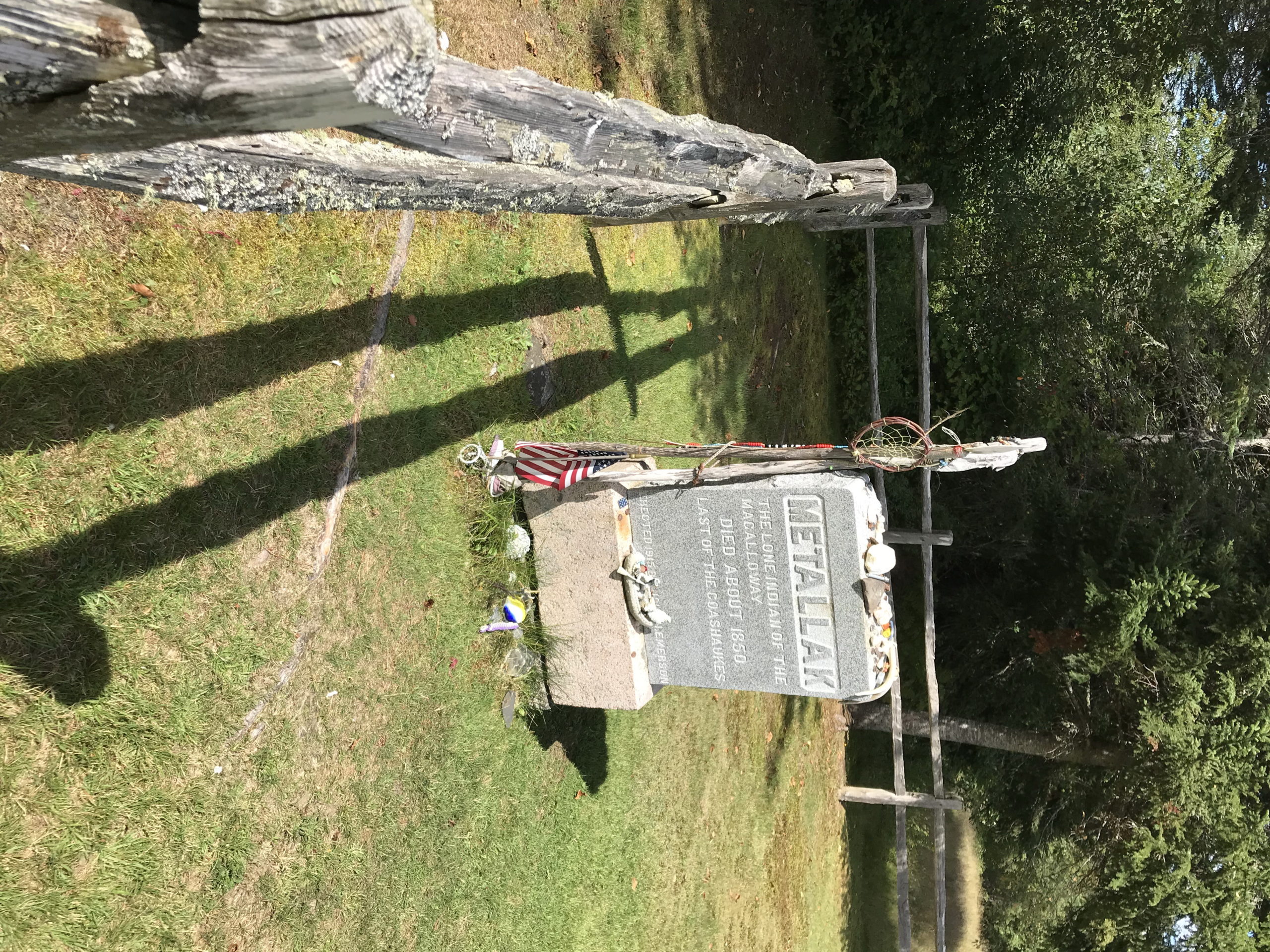
Metallak: "The Lone Indian of the Magalloway"

Gravesite of Metallak in North Hill Cemetery, courtesy of Tom Childs. Used with his written permission.

Reputedly the “son of a chief,” Metallak [sometimes spelled Mettalak] was one of the Native Peoples. He lived  in the lake region of New Hampshire. Some identify him as “the last of the Pennacook,” however he certainly was not the last of his band.

Others still say he is the son of Philip, an Abenaki chief from the St. Francis tribe. It has been said that Philip sold 3,000 square miles to two separate groups of men. This sale was New Hampshire’s claim to the Indian Stream Republic. Reportedly in 1836 Metallak sold this land once again.

Farrar’s Illustrated Guide to the Androscoggin Lakes states, states “from his earliest youth [he] was taught the use of weapons and the craft of the woods. He grew up tall, lithe, and active, the pride of his tribe…He built his lodge in the old home of his tribe, the Coo-ash-aukes, on the waters of the Amariscoggin….”  One legend about Metallak says that he rode on a moose. Continue reading

Posted in N.H. Historical Markers, Native Peoples, New Hampshire Men | Tagged , , , , , , , , , , , , , , , | 2 Comments

An Irish Invasion

To Mike O’Laughlin of Irish Roots Cafe, for mention in his podcast #42 as his “Web Site of the Week:   Go raibh maith agat!    (Many thanks!)

*********************************

If you are Irish, or just wish you were, consider submitting a blog article with a Celtic- Irish- slant to the First Edition of the Carnival of Irish Heritage and Culture.  This carnival is being hosted by Small-leafed Shamrock.

Janice

Posted in Carnivals and Memes | Tagged , , | Leave a comment

Up A New Hampshire Christmas Tree, by B. Elwin Sherman

Yes, it’s possible to celebrate Christmas somewhere other than New Hampshire.  I’ve done it, even once harking my heralding angels for a winter in Tucson, Arizona.  But, as a native Granite Stater in the desert, I just couldn’t warm up to jackalope reindeer, Frosty The Sandman, and hanging tinsel on a barrel cactus with the same degree of Ho-Ho-Holiday cheer, so I came home to snow country.

This is not to say that we’ll have a white Christmas here, though fresh snowfalls in my New Hampshire childhood were never in doubt through the Yule.  Fifty years ago, it was a question of how much, not if, we’d have snow for the Holidays, and the only global warming ever mentioned came from spiked punch.

Layered in winter clothes and looking like a miniature Admiral Peary, I’d take my new Christmas flying saucer and scale the driveway snowbank peaks, all lofty enough to have their own names.  I christened them after famous dogs:  Lassie’s Leap.  Rin Tin Top.  Huckleberry Hound Hill.  Sally’s Slide.

The latter was so-dubbed for my dog, Sally, famous (to me) for her willingness to join me on my silver metal snow disk, and having good sense enough to jump off before we crashed into the shed.  No matter, because boy bravado was measured by the number and depth of one’s saucer dents, and mine had enough to make it steer like a flying cup.

I’m also old and bold enough now to admit that I once snow-sculpted one of my backyard saucer summits into a likeness of our former Franconia Notch icon.  I used a shovel and hedge trimmers, and called it: “The Old Boy Of The Mountains.”

As a younger boy, I always wanted to be an older boy, and I used to wish for this at Christmas.  Older boys could stay up late and drink all the eggnog they wanted.  Now, I have to stay up late and shouldn’t have drunk all that eggnog.  Careful what you wish for.
I also regret never having told my Dad that his hedge trimmers weren’t stolen.  When the spring snowmelt didn’t reveal them, I knew they’d been picked up and “borrowed” into history by Crazy Ed The Handyman.

I don’t have to tell rural dwellers about Crazy Ed.  If you live in the country, you have one of your own.  He’s the only odd-job guy who can never quite finish all the chores you don’t need half-done, but will settle for, because if you didn’t half-do them yourself it would cost more in chiropractors than it would if you paid Ed for not doing what he doesn’t do when he finally never gets to them.

Still, half an unshingled roof unfinished beats a whole roof never shingled at all, and the true meaning of Christmas can be found in all of that somewhere.

I won’t go too much into gift giving.  If you’re stuck, and haven’t been provided a wish list by the giftee, try something unusual this year, like “The Cracker Whacker” (I’m not kidding).  It’s a specialized slingshot capable of throwing a Ritz Cracker 60 yards.  “Serve the fastest snack at your party!” says the ad.  Crazy Ed will love this, but you’ll have to find a way to get it to him when he doesn’t show up to not finish what he half-started before he never came the last time.

I do like giving one-of-a-kind gifts, and how better to please your sister-in-law feline fancier than with: “A Cat pyramid litter box extruded in black or white plastic with metallic gold hieroglyphics.  A fun place for kitty to go!”  (Google it, if you don’t believe me.)  Silly?  Perhaps.  But, I’d never belittle the eccentricities of pet owners.  I still believe that if you’re going to leave Muttley at home alone, you should keep the TV on and tuned to the Animal Planet (he likes dog show competitions the best.  Even your pooch needs an American Idol).

Meanwhile, there is one activity uniquely suited to Christmas in New Hampshire:  Cutting your own Christmas tree.

There are three rules:

1.  Remember, your eyes are always bigger than your living room, and trees outdoors always look smaller than they will actually be when brought indoors.  Measure carefully, unless you don’t mind removing ceiling tiles, admiring a horizontal angel atop a trapezoidal shrubbery, and storing your couch in the kitchen for the Holidays.

2.  When strapping your prized Tannenbaum to the top of the car, do so with the stumpy end facing forward, ESPECIALLY if you’re taking the interstate home.  If you overlook this logistic, you’ll arrive having to convince the family of the fun you’ll all have trimming the family stick.

3.  Please patronize one of the many Christmas Tree Farms in New Hampshire.  You’ll find one nearby by visiting: nhchristmastrees.com online.  Many of these locations offer “sleigh rides, caroling, hot cider and doughnuts, and even Santa Claus himself.”

Merry Christmas!
I’m off to measure the ceiling.

* * * * *
B. Elwin Sherman still has to move his couch every Christmas, and sends his humor column from the New Hampshire upcountry and his website at: elwinshumor.com.  His column appears here with permission.  Copyright 2007 B. Elwin Sherman.  All rights reserved.
* * * * *

Posted in History | Tagged , , , | Leave a comment

Cooking in Colonial New Hampshire

In colonial New Hampshire, the kitchen fireplace was the first and largest of all the hearths in the early home.

This immense fire consumed large quantities of wood, selected and arranged in a particular order as fore-stick, back-stick, and kindling material. The food of the early settlers was usually boiled, roasted or fried. Resting on fire-dogs or andirons, the fuel burned, while pots and kettles, suspended on the crane by pot-hooks and trammels (hooks at different heights), contained several culinary preparations. Fish and meat, and other food items were often broiled or grilled on a gridiron. Baking was accomplished through the reflecting surfaces of the tin baker, or by a cruder method of burying the food in the ashes. Later a brick oven was used in food preparation.

Sometimes a fireback (a large cast iron plate) was placed at the back of the fireplace, to keep the heat from destroying the stone and mortar at the back, and helping to radiate heat into the room.

Photograph of a typical colonial fireplace used for cooking.

Photograph of a typical colonial fireplace used for cooking. Property of J.W. Brown. Photograph taken in an early colonial house still in existence.

Cooking utensils in early American kitchens were scarce.  Even the wealthiest households had only a few–usually had a large kettle, one or more small ones, a skillet or two, a frying pan, a gridiron, irons pots, a dripping pan, and possibly a warming pan.  Tables and chairs, eating implements, plates, cups, bowls, and other items were extremely rare in colonial America. Napkins and table cloths were even rarer.

The introduction of stoves gradually brought about a revolution in women’s domestic affairs. The first iron cook stove was cast in 1765, and the first stoves were of very thick iron castings, and much heavier than later stoves. Throughout the 1800s hearth cooking slowly disappeared.

In the earliest days of New Hampshire’s settlement, the fire of the domestic hearth was renewed by the use of flint, a steel, and a supply of tinder (or by borrowing some coals from a neighbor if you had one). The introduction of the Lucifer match, [see example] [see Dec 15th article] put an end to the less convenient practice of kindling.

The average diet was made up of boiled, steamed and stewed meat and fish, vegetables such as peas and squash, cornmeal cakes and pudding, and berries. Later they added pumpkins, melons, fruit trees and other vegetables to their gardens (including the potato, first planted in Londonderry NH).  New Englanders often preferred to eat the four B’s — bacon, beans, butter and bread. Everything was fried with lard–pig fat.

One of the earliest “true American” recipes was that of “succotash.” Taught by the Native Peoples to the colonists by the early 1660s, it was a mix of boiled beans and cooked dried corn, roots, squash and fowl. The colonists added salt pork, and potatoes (when they were introduced).

Janice

Some Sources:
1. Life and Times in Hopkinton, N.H. By Charles Chase Lord
2. Misc other sources

Posted in History, New Hampshire Women, Recipes | Tagged , , , , , , , , , , , , , , , , , , , , , , , , , , , , , , , | 4 Comments