Portsmouth, the only port worthy of the name on New-Hampshire’s eighteen miles of sea-coast, was originally planted as a mercantile settlement, and not a religious colony. And this peculiarity of her origin has impressed itself on every phase and period of her history.
Accordingly we find her, and the province of New-Hampshire, of which she was at once the head, and the largest member, getting along without a press from 1723 until 1756; and when at length the press did come, it was first used to print an almanac and newspaper; and indeed this first press was never used in printing many books.
The history of printing in Portsmouth is thus mainly the record of newspapers and editors; although considerable book work was done at one time, about the close of the last century, including a heavy edition of Rollin’s Ancient History, by Treadwell & Brother, in 8 vols. Charles Tappan, Charles Peirce, Gray & Childs, T.H. Miller, and C.W. Brewster also issued several works, at a later date; and Mr. Miller also printed music, and his were the only specimens ever issued in the state, as far as I can ascertain, except the publications of Henry Ranlet (and possibly others) at Exeter, which were considerable.
Daniel Fowle, the first printer in New-Hampshire, who established the New-Hampshire Gazette in Portsmouth, Oct. 7, 1756, was a native of Massachusetts, and his record shows him to have been a fair printer, and able editor; successful in business; a true patriot, and a good man. He commenced business in Boston, in 1740, and in 1750 published the Independent Advertiser, in connection with Gamaliel Rogers. Fowle afterward opened a bookstore and printing office in Boston; and in 1754 was arrested by order of the Massachusetts house of representatives, on suspicion of having printed a pamphlet entitled, “The monster of monsters; by Tom Thumb, Esq.,” which contained severe animadversions on some of the members. After the rudest and most insolent treatment, he was taken to the common jail, and confined in the same cell with a notorious thief, and next that of a murderer awaiting execution. After three days he was set at liberty, but refused to go; he had been confined, uncondemned by law, and demanded that the authority which had imprisoned, should release him. But after staying with the jailor three days longer, and learning that his wife was seriously ill from anxiety on his account, he returned home. He afterward published an account of these arbitrary proceedings in a pamphlet entitled, “The total eclipse of liberty.”
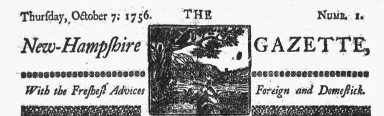
In vain endeavoring to obtain satisfaction or indemnity for his illegal detention, and disgusted with the provincial government of Massachusetts, he determined to leave Boston; and sought the freer soil of New-Hampshire. Accepting the invitation of several “respectable” gentlemen of Portsmouth, he removed to this town; and early in October 1756, issued here the first number of The Gazette, on a sheet which, laid open, measures seventeen inches by ten–an exact facsimile of which is furnished in each copy of this number of the REGISTER. The Gazette, now in its one hundred and sixteenth volume, is still published at Portsmouth, being now issued in quarto form, on a sheet 29 x 42 inches. The present office is on the same street, and not many rods above the original location, but there have been numerous other sites occupied in the mean time.
It will be seen that no place of issue is stated in the publisher’s imprint or elsewhere; but a daughter of the late John Melcher, Esq. (Fowle’s successor and heir), still living, states that the singular and quaint photograph by Davis Brothers, of Portsmouth), was Fowle’s original office, and so the site of the first printing in New Hampshire. It is located on the corner of Pleasant, Washington and Howard streets, and opposite the beautiful and famous old Wentworth mansion; in the near vicinity of the original meeting-house, and in what was then the business centre as well as the “court end” of the town. The office (that is the material and the business,–not the building) was after a few years moved by Fowle to Fore or Paved street, now Market; but had it been retained in the first location, it would have escaped the fire which have several times visited in in various others, but which have never devastated the south end of the town.
Fowle’s opening address is pronounced by Rev. Dr. Peabody to be a masterpiece of its kind; and no one can inspect the volumes of the paper under his management, without conceiving a most favorable idea of his ability and discretion, integrity and honor, public spirit, and patriotism. He continued in business in Portsmouth for about thirty years, until 1784, for a portion of the time having a less worthy nephew connected with him; but for the most part assisted chiefly by his negro slave, Primus, an excellent pressman, although he did not know a letter, and who lived to the age of ninety. Dr. Peabody also remarks, “that the N.H. Gazette is believed to be the only newspaper in this country which has had a continuous existence for a century, without a change of name.” But this was said in 1856, at the centennial celebration of the Gazette; and since that time, at least two others have completed their hundred years. The North American in Philadelphia, and The Newport Mercury in Rhode Island.
Pictorial illustrations were perhaps as popular then as now, but engravings were scarce, and engravers scarcer. Fowle had brought with him, from his Boston printing office, a set of wood-cuts, probably of Aesop’s fables; and with that of the fox and the crow, as will be seen, the head of the Gazette was at first adorned. Whether the public was the crow, and Fowle the fox, we cannot say, nor how the emblem or device was to be taken; but this cut was soon broken, and was replaced by that of Jupiter and the peacock. Some time afterward the royal arms took the place in the head, and kept it until displaced by the American revolution.
Mr. Fowle did little else than print the paper, the province laws, and a few pamphlets. The governor appointed him a justice of the peace soon after his arrival. He was a correct and industrious printer, and an agreeable man, and succeeded in accumulating a considerable property. He published the Gazette, alone or without a partner, until 1785; when he transferred it to John Melcher and George Jerry Osborn, two of his apprentices. Mr. Fowle died in 1787, aged about seventy years, leaving most or all of his estate to John Melcher, according to his agreement when young Melcher went to live with and work for him. Melcher died in 1850, aged nearly ninety years, and his highly respectable descendants are still enjoying the competency thus gained from Fowle, and increased by himself.
The exact chronology of the Gazette is as follows: Daniel Fowle printed it from 1756 to 1764, when Robert Fowle became associated with him. They continued until 1773, when Robert went to Exeter and started the first paper there. In 1776, Benjamin Dearborn became publisher; but two years after, Mr. Fowle again resumed the publication, and continued it to 1785, when Melcher & Osborn took it. A part of the old wooden building, then standing on what is now Market street, which was occupied as a printed office by Fowle and his successors, is now a dwelling on Russell street.
Mr. Osborn soon left the firm, but Melcher continued the business of printer and bookseller until 1802, when he sold out to Nathaniel S. & Washington Peirce, who changed the politics of the Gazette from federal to republican. Melcher was the first state-printer of New-Hampshire, and the only Portsmouth citizen who has ever filled that office. He imported a font of pica type upon which to print the laws of the State, and it was in regular use for more than sixty years. The writer now has in his possession, the original press used in printing the Gazette, also a large earthen inkstand, a settee, and several founts of type, which descended from Fowle to Melcher, and were bestowed by his family on the writer’s father, the late Rev. Tobias H. Miller, himself a prominent editor in this city for nearly fifty years past, until 1870. Mr. Melcher filled the high office of coroner for many years, was a very exact and accurate printer and business man, and having made a snug property in his trade, lived in the best of health and spirits almost half a century after he retired from it. The writer of this well remembers his nice, prim appearance as a veritable gentleman of the old school, in our streets, during his last years.
N.S. & W. Peirce, in connection with Benjamin Hill and Samuel Gardner, published the Gazette about three years, and in 1805 sold it to William Weeks, who came from Portland, Me. Up to this time very little editorial matter had appeared in the paper, except a little political writing at certain periods. The scissors (or, rather, penknife) did most of the work, as they often do the best of it now. The”news” and selected matter were all that was expected–and it was of no consequence if the news from Washington was several days, or from Europe several weeks old, instead of hours or minutes, as it is now. Mr. Weeks held an able pen, and wrote more than his predecessors. He remained editor for more than four years of a stormy period, and at the close of 1813 was succeeded by Beck & Foster. This firm continued until dissolved by the death of David C. Foster in 1823. From that time until 1834, Gideon Beck was the next publisher; then Albert Greenleaf was admitted partner, and the next year, 1838, Mr. beck left the business. Now appear the names of Thomas B. Laighton (afterward well known at the Isles of Shoals), and Abner Greenleaf Jr., in the imprint, for a year or less; when Mr. Greenleaf alone conducts the paper up to 1841. Then Joel C. Virgin and Samuel W. Moses printed it until 1843; then Mr. Moses for a year. After this Abner Greenleaf (senior) is named as editor, then A. Greenleaf & Son. This year, 1844, closes without any imprint, and for the next two years there was none, the paper being then owned by prominent democrats, and managed by them and their friends.
In 1847, William P. Hill, a son of Isaac Hill, came from Concord, in this state, and bought the Gazette, and also another opposition sheet which had been started; and uniting the two, enlarged the Gazette, and called it “The N.H. Gazette and Republican Union.” He was unsuccessful, and lost several thousand dollars in the publication; and after in vain attempting to establish a daily Gazette in connection therewith, he left the paper in 1850, and was succeeded by Gideon H. Rundlett, of Portsmouth, who ably and faithfully edited and published the paper for its owners, who were leading members of the democratic party.
Edward N. Fuller, from Manchester, relieved Mr. Rundlett after his two years’ service in 1852, and remained in charge of the business until 1858, when, after making another creditable but unsuccessful attempt to establish a daily Gazette, he left the state, and was for several years connected with the Newark Journal in New-Jersey. Mr. Fuller was an able man and skillful journalist, but had a difficult field to work in here. He was succeeded in the management of the Gazette by Amos S. Alexander, Esq., from Fisherville–a man of more ability than discretion in the use of his pen; a most social and agreeable gentleman, of Falstaffian personal proportions. This “Alexander the Great” (as he was sometimes called by rival editors) was obliged to vacate his position as custom-house officer and editor, in favor of Mr. Samuel Gray of Portsmouth, who now bought the office, in February, 1859. Mr. Gray was a good printer, and capable business man and conducted the paper to the satisfaction of its patrons, until Sept. 14, 1861, when he sold out to Frank W. Miller, who united the Gazette with the Chronicle (a daily and weekly paper established in 1852 by these same men, with others, then partners, as Millers & Gray), in which connection it is still published, the daily being known as “The Portsmouth Chronicle” and the weekly as “The New-Hampshire Gazette.”
In 1857, the firm of Millers & Gray (the third member having been Thomas W. Miller who deceased in 1856) was dissolved, F.W. Miller remaining as sole owner and publisher. In 1858 he purchased the New Hampshire Phenix, a temperance paper printed in Concord, and put the titles of both at the head. This cannibalistic performance of swallowing numerous other papers, has been the experience of many old publications.
Mr. George W. Marston was admitted partner with Mr. Miller, April 13, 1868, under the style of Frank W. Miller & Co.; and Mr. Miller sold his interest to Mr. Washington Freeman Oct. 13, 1870, since when the business is conducted by Marston & Freeman.
The Gazette was strongly loyal for many years; so much so, that in 1765 it was feared the editor would not oppose the stamp act vigorously enough, and another paper called the Portsmouth Mercury was started, but after three years it ran out. In 1802 the Gazette was changed to republican, but about Jackson’s time espoused the democratic cause, and followed the fortunes of that party until united with the Chronicle. Thenceforth, with T.H. Miller continuously, and three of his sons at different times as editors (with whom Jacob H. Thompson, now of the New-York Times, was for years a valuable assistant), and later under Mr. Marston’s management, the Gazette has been and is a supporter of the republican party.
It must not be supposed that the printers of the Gazette enjoyed a monopoly of the business in Portsmouth during all these years. Far from it. Nearly or quite thirty other different papers have been started, and for the last eighty years there have been commonly three weeklies issued, and within twenty years two dailies have been established in addition,–the Daily Times in 1868. Of these, up to the time of the very successful Chronicle, in 1852, only one had succeeded, with any degree of permanence,–the Oracle, now Portsmouth Journal.
In 1793, Charles Peirce commenced a semi-weekly called the “United States Oracle of the Day,” but in about two years changed it to a weekly, and in 1801 sold it to William Treadwell; and after passing through other hands, the name was altered to “Portsmouth Journal” (which it still retains), by N.A. Haven Jr. who became editor in 1821, and it was in 1825 sold to Charles W. Brewster and Tobias H. Miller, both recently deceased. In 1835, Mr. Brewster bought out Mr. Miller, and the paper is still published by his son, Louis W. Brewster, for several years his partner, and is one of the most substantial and highly esteemed family journals in the State. As a characteristic, it has the same small, neat heading which it has borne for a large portion of its whole existence of three-quarters of a century.
Mr. Brewster, senior, made one or two efforts, many years ago, to start a small daily, but not immediately receiving what he deemed to be adqueate encouragement, he declined to go on. His two volumes of valuable and interesting local history, known as “Rambles about Portsmouth,” and his noble essay entitled “Fifty years in a Printing Office,” are, in addition to his weekly Journal, an ample record of a well-spent life. Verily, his works do follow him, and his children rise up and call him blessed.
His old partner, Tobias H. Miller–printer, editor, publisher, and minister of the gospel,–was for more than half a century prominent connected with the press of his native state; and no doubt, at one time or other, was interested in more different newspapers than any other man who ever lived in New Hampshire. As an editor, few have shown more ability or been more popular, though he was as outspoken as Fowle; but, unlike Fowle, he cared not to amass wealth. He was a clergyman of good standing, first in the Orthodox Congregation, and afterward in the Universalist denomination; and keeping both pen and voice active almost to the day of his death, he was a year or two since gathered with our list of worthies, of whom he was proud to be accounted one. His six sons have all had more or less connection with the printing office, four of them being editors of newspapers.
It is curious to look at the ages of the first printers of Portsmouth. Fowle lived to be about 70 years old, working nearly fifty; Primus, his slave, to be 90, working more than fifty; Melcher, Fowle’s apprentice, to be 90, working nearly thirty years; Samuel Whidden, Melcher’s apprentice, and in part his successor, to be 70, working forty-five; and T. H. Miller, who first worked with Whidden, to be 68, working fifty-five. Of all these men, probably the first, Daniel Fowle, made more money by the printing business, than has ever been made by any other in the state, even to the present day; although Mr. Melcher, who inherited Fowle’s property and increased it in other ways than by printing, doubtless gathered a larger estate than he. Fowle held the office of justice of the peace, a position conferring power and emoluments in those days; Melcher was for years the coroner, a respectable and profitable office; and in later times, even to the present, the publisher or editor of the Gazette has usually been the recipient of some profitable government office, in the customs or postal department. Before the year 1800, eight several and distinct papers competed with the Gazette, at different times; since that time, at least twenty of all sorts have begun and ended. Of the men, besides the Gazette pioneers, and their near followers, Charles Peirce, who started the Oracle (now Journal) and the late lamented Charles W. Brewster, also of the Journal, all of whom accumulated a comfortable competency, few if any of their numerous competitors and followers, except the Chronicle publishers, have added much to their substance by their hard labors, though some of them were very able and worthy men. The Oracle and Journal throughout have had able writers. The Gazette, from the time Mr. William Weeks took it, in 1805, has been actively edited, and usually with ability.
It is fitting and proper here to note the fact that the antiquity of the N.H. Gazette has been disputed and denied by some, especially by the Newport Mercury of Rhode Island, which was started two years after the Gazette, by Benjamin Franklin’s less worthy brother James. The form, size and entire make-up of the little Mercury (as shown by the facsimile issued at the time of their centennial celebration in 1858) clearly evinces that it was patterned, as near as might be, after Fowle’s Gazette; and the Mercury bases its claims to a great antiquity than the Gazette, on the statement that the Gazette was for a year or more, about 1775, suspended from publication, or else published under a different name. But neither of these statements are true, as the files and all the records of history show. For although there have at various times been several other titles connected with that of New-Hampshire Gazette, this has never been omitted, nor has the paper ever failed of regular and continuous issue. There appears at one time to have been another New-Hampshire Gazette, printed at Exeter, fourteen miles distant from Portsmouth, by one Robert Fowle, whom Dr. Peabody alludes to as an unworthy nephew of the great Daniel; this was issued irregularly for a year or two, first called “A New-Hampshire Gazette,” and afterwards, “The New-Hampshire Gazette,” and its brief existence many have caused the misapprehension as to the veritable Gazette. At any rate, the bound files of the Gazette, which still exist, almost complete if not entirely so, in the Athenaeums of Portsmouth and Boston, show that this charge is not correct, and the evidence is good and sufficient of the superior age of the paper. Rev. Dr. Peabody, in his address, sustains this view; and the late Rev. T.H. Miller, who had thoroughly studied the subject, also insisted on it. Thomas, in his “History of Printing,” more than half a century since said “The New-Hampshire Gazette is the oldest paper in New-England,” –and it is very certain that it has not grown any younger, nor any of its contemporaries relatively any older since. The files show that the name of N.H. Gazette and Historical Chronicle was, on May 25, 1776, changed to Freeman’s Journal or N.H. Gazette; and about one year afterwards was again changed to N.H. Gazette, or State Journal and General Advertiser. But the original title of New-Hampshire Gazette, which Fowle gave it, has always been sustained at the head of the paper, and this is beyond question the oldest paper, not only in New-England, but in the United States. And there is only one other paper, so far as I can discover, that at any time, within many years back, could have disputed successfully the claims of the N.H. Gazette to priority in the Union. We allude to the Virginia Gazette, which was established at Williamsburg in 1736, twenty years before Fowle’s, and was the third paper started in the country. The publishers most of the time during the last twenty years have been two brothers of the name of Lively, to whose courtesy I am indebted for some information concerning the paper, and for copies of the last issues, as late as 1869, which show them to be able journalists. Mr. Lively states that he has valuable bound files of the paper, sufficient to fill a horse-cart; but that its publication has been suspended and resumed several times during its long career,–if, indeed, such an interrupted and broken series of existences can be termed and counted as one and the same life. In one case, at least, Messrs. Lively abandoned the old historic name, but resumed it again after a few months. In 1862, this Virginia Gazette was necessarily discontinued for a while, by reason of the U.S. forces occupying the town of Williamsburg,–and a sheet was issued from the office by some of the printer “boys in blue…”
A very interesting celebration of the one hundredth anniversary of the introduction of printing into New-Hampshire,–really the celebration of the establishing of the Gazette,–was held in Portsmouth, October 6, 1856. The movement was originated by the New-Hampshire State Historical Society, and was largely indebted for its success to the intelligent and untiring efforts of Edward N. Fuller, Esq., of Utah. Mr. E.N. Fuller published at the time, a pamphlet of sixty pages, containing a full account of the proceedings on the occasion,–the street procession and decorations, and the indoor festivities,–the oration, poem &c in the Temple, originally the church built for Elder Elias Smith; the dinner in the old historic Jefferson Hall, with the after-feast of speeches, sentiments, &c. The oration of Rev. Dr. A.P. Peabody, then pastor of the Unitarian Church in Portsmouth, and editor of the North American Review, although written at very short notice, was of course an able and eloquent production, and no less a glowing tribute to the art personated, than a valuable compilation of and contribution to the general and local history of the craft, the devotees of which perhaps have proved themselves generally less crafty than most other guilds. Benjamin P. Shillaber, Esq., well known as Mrs. Partington, delivered the poem on the occasion; and Albert Laighton, who has been styled the poet of New-Hampshire, and Thomas B. Aldrich, wrote odes which were sung by a select choir,–all the three poets being natives of Portsmouth.
The famous battalion of Amoskeag Veterans, from Manchester, N.H. under the command of the late Chandler E. Potter, the well-known historian, performed escort duty for the street procession, which embraced the fire department and military and civic organizations of the city, and a small mechanical department. The great attraction was the old wood and stone printing press (often called Ramage, but of course much older-1 than that pattern) which had been owned and worked by Franklin J. Draper of Boston, and Daniel Fowle and John Melcher of Portsmouth, and upon which the New-Hampshire Gazette was first printed. This historic press was set up in a hay rack in the most outre style, and was operated as the procession moved along the streets, with the old ink-balls and all; and fac-similes of the first newspaper printed in the state (like that presented herewith) were distributed to the eager populace, just a century from its appearance from the very same press.
Of the numerous and significant decorations of buildings, we can only refer to two. At the corner of Howard and Washington streets, and very near Pleasant, still stands the queer shaped old wooden building which was used by Fowle for the first printing office in the state, and of which we present an engraving with this article. This structure was decorated agreeably to the suggestions of the writer hereof, with a large painting of the Draper printing press, behind which was seen the rising sun, and over all, the words, “Let there be light!” Underneath all, the inscription, “Success to the craft which puts down kingscraft and priestcraft.” Flags were suspended across the street at this point, and the bands as they passed saluted the sacred spot. At the office where the Gazette was then published, on Daniel street, there was erected a fine national arch, surmounted by an eagle and flags, on the pillars of which appeared thirteen starts, and on the keystone, “Daniel Fowle, 1756” “To him whose memory our art endears, We yield the homage of a hundred years.”
There was also a colossal bust of Franklin, the wooden figurehead, we think, of the old U.S. ship Franklin, and which is now displayed in the grounds of Portsmouth Navy Yard.
The after-dinner speeches at Jefferson Hall were especially interesting. Mayor Richard Jenness presided, and Hon. Frank Fuller was toast-master. Among the sentiments responded to, was one to “Daniel Fowle,” by the Rev. Tobias H. Miller, who has recorded nearly all of the canty knowledge we have of Fowle’s history, and that of John Melcher his next successors. Benjamin P. Shillaber also read a humorous poem, and Mr. Charles W. Brewster worked into ingenious rhyme many of the names of the numerous poets of Portsmouth. Father Boylston of the Amherst Cabinet, and the veteran Father John Prentiss, long of the Keene Sentinel (who is still living at the age of ninety-four years) entertained the company with anecdotes and reminiscences of their times. E.N. Fuller, Esq. spoke for the Gazette and named many whose able pens had enriched its columns… Besides the exercises already alluded to, the visiting multitudes were entertained with a rowing regatta on the Piscataqua river, and a grand centennial ball was given at Congress Hall in the evening.
Written January 1872–Communicated by Frank W. Miller, Esq. of Portsmouth NH
Janice
–The New Hampshire Gazette Online–
–The New Hampshire Gazette History Links (archived version)–