New Hampshire 1878: How the Weather is Foretold

Headline:  How the Weather is Foretold.
In former times the chief herald of the weather was the almanac, which ambitiously prophesied a whole year of cold and heat, wet and dry, dividing up the weather quite impartially, if not always correctly.

But the almanac, good as it was now and then, and the weather-wise farmers, correct as sometimes they might have been, were not always able to impart exact information to the country; and they have been thrown quite into the shade of late by one who is popularly known under the somewhat disrespectful title of “Old Prob,” or “Old Probabilities.” He has become the Herald of the Weather to the sailor near the rocky dangerous coasts; to the farmer watching his crops, and waiting for good day to store them; to the traveler anxious to pursue his journey under fair skies; and to the girls and boys who want to know before they start to the woods for a pic-nic, what are the “probabilities” as to rain.

Everyone who reads the daily papers is familiar with the “Weather Record,” issued from the “War Department, Office of the Chief Signal Officer,” at Washington. These reports give a general statement of what the weather has been for the past twenty-four hours all over the country, from Maine to California, and from the Lakes to the South Atlantic States; and then the “probabilities” for the next twenty-four hours over the same broad territory.  The annual reports of the Chief Signal Officer show that only in comparatively few instances do these daily predictions fail of fulfillment.

The reasons these prophecies are so true is simple and yet wonderful. The weather itself tells the observer what the weather is going to do, some time in advance, and the telegraph sends the news all over the country from the central signal office at Washington.

We shall see presently how the weather interprets itself to “Old Probabilities.” Although it has proved such a fruitful subject of discourse in all ages, yet I am afraid many people who pass remarks upon it do not really think what the weather is made of. Let us examine its different clements.

The atmosphere has weight, just as water or any other fluid, although it seems to be perfectly bodiless. We must comprehend that the transparent, invisible air is pressing inward toward the center of the earth. This pressure varies according to the state of weather, and the changes are indicated by an instrument called a barometer. Generally speaking the falling of the mercury in the tube of the barometer indicates rain, and its rise indicates fair weather. Sometimes the rise is followed by cold winds, frost and ice. What these changes really indicate, however, can be determined only by comparing the barometric changes at certain hours, in a number of places, very far apart. This is done by the Signal Service.

Observations are made at about one hundred and forty stations, in different stations, in different portions of the country, at given hours, and the results are telegraphed at once to Washington, where our faithful “weather clerk” receives them, reasoning that from them the “probabilities” which he publishes three times in every twenty-four hours.

But the atmosphere varies not only in weight but also in temperature. The thermometer tells us of such changes. Besides this, the air contains a great amount of moisture, and it shows as much variation in this characteristic as in the others. For the purpose of making known the changes in the moisture of the atmosphere, an instrument has been invented, called the “wet bulb” thermometer. We are thus enabled to ascertain the weight of pressure, the temperature and the wetness of the air, and now it only remains for us to measure the force and point out the direction of the wind. This is done by the familiar weather vane and anemometer. The vane shows the direction, and the anemometer is an instrument which indicates the velocity of the wind.

It is by a right of superior understanding of all these instruments that the signal service officer is enabled to tell what the weather says of itself; for they are the pens with which the weather writes out the facts from which the officer makes up his reports for the benefit of all concerned. Thus however wildly and blindly the storm may seem to come, it sends messengers telling just where it arose, what course it will take, and how far it will extend.  But it tells its secrets to those only who pay strict attention.

Source: Farmer’s Cabinet, Amherst NH, 9 October 1878; Vol 77, Issue 10, page 1.

**READ MORE**

United States Army Signal Corps

Posted in History | Tagged , , , , , | 1 Comment

Lebanon New Hampshire’s "Man Who Survived With A Hole in His Head": Phineas P. Gage (1823-1860)

A great deal has been written about New Hampshire native, Phineas P. Gage.

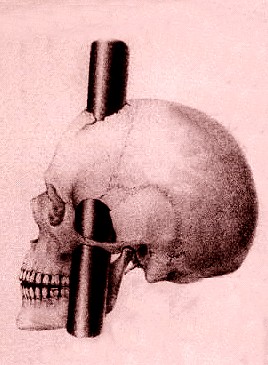
Graphic of skull from “The history of the development of medical science in American by Henry R. M. Landis, 1901. Internet Archive.

He was the victim of a freak accident, and lived for to tell the tale (actually for 19 more years). Perhaps the most succinct story comes from “The Connecticut River Valley in southern Vermont and New Hampshire,” by Lyman S. Hayes:  historical sketches, by Lyman S. Hayes as follows: “During the building of the Rutland road, September 15, 1847, a peculiar accident occurred which in all the intervening years has been considered the most remarkable in its results of any recorded in the medical world.  A workman named Phineas Gage had a long iron bar blown entirely through his head and brain, by a premature discharge of a blast while making the rock cut a mile east of Cavendish station. The strange thing was that the man recovered and was able to work about 19 years thereafter. It was such a marvelous thing to relate that it was doubted by physicians everywhere and close investigation was made by surgeons from other states.  Continue reading

Posted in Genealogy, New Hampshire Men, Not New Hampshire | Tagged , , , , , , , , , , , , , , , | 4 Comments

Brooke Astor Dies At 105

Brooke Astor, the last of the American branch of the Astor family (by marriage) died yesterday at her New York estate, Holly Hill in Briarcliff Manor, reportedly of pneumonia.

She is survived by her only child, Anthony Dryden [Kuser] Marshall, two grandsons, Philip and Alexander Marshall, and several great-grandchildren. She had two step children by her marriage to Charles Marshall, i.e. Peter Marshall and Helen Huntington Marshall.

“I grew up feeling that the most important thing in life was to have good
manners and to enhance the lives of others,” Brooke Astor said in a 1992
interview with The Associated Press.

Several newspapers have reported that he chose the following epitaph for her gravestone: “I had a wonderful life.”  And indeed she did.  Funeral to be held on Friday, August 17, 2007.
Recap of her Funeral.

Janice

Also see several articles I’ve written about Brooke Astor that include her family tree.

Posted in Current Events | Tagged , | Leave a comment

Five Fun New Hampshire Summer Entertainments For A Cheapskate

Almost every town has a park, common, beach, or a common area where residents can gather (if yours does not, visit surrounding towns and discover theirs).

The first three games in this list are definitely outside entertainments.  The remaining two can also be enjoyed inside, should the weather take a turn for the worst.

You may already have most of the items needed for these games. If not, consider taking one day to visit some yard sales in advance, looking for kites, frisbees, paper suitable for origami, bubble wands, and marbles.

1. Fly a kite in your local parkFirst, make your own kite!

2. Play frisbee golf at your local park. (You will of course need at least one frisbee).  Either mark off (using ribbon tied around trees) your course, or make a map. Count the number of throws it takes for you to hit the next “hole.”  Person with the lowest score wins. Be sure to clean up when your game is done. Note: this sport, also called Disc Golf, has gone professional, DOH!

3. Blow bubbles.  Have a bubble blowing contest (i.e. largest bubble, bubble that drifts the furthest etc.  Make your own bubble tube and bubble formula first.

4. Create origami.  Take leftover paper, wrapping paper, or construction paper outside on your deck, or picnic table (obviously on a day that is not too breezy). Use some of the diagrams for creating origami on the internet, and some for paperfolding. There are even web sites dedicated to kid's origami.

5. Play marbles.  Most of us have some of these hanging around, but we never learned to play. You can either draw the rings on the ground, OR you can use chalk to draw the needed circles on pavement.  Learn how to play here, and here, and here.

If you know of other almost free things to do (for all ages) please share.  And most of all, have fun!

Janice

PS: Also see -Four Strangely Amusing New Hampshire Entertainments-

Posted in Current Events | Leave a comment

Genealogy Seminars I'd Like to See

The .30th Edition of the Carnival of Genealogy's. topic is Genealogical Conferences & Seminars. I've never attended one of these, but I might if the subject matter presented was odd enough…errr was of great enough interest to me.

I'll fess up that my seminar interests would probably not appear in any of the traditional conferences (mostly because I have yet to find a “Bizarre Twist” category). If Chris Dunham, the “Master of Fractured Genealogy Top Ten Lists,” was willing to explain his creative methodology, I'd be the first in line to sign up.

Genealogy Seminars I'd Like To See include:
(*the stories marked with an asterisk are really about the topic I've posted).

– Digging Up Dirt Through Cemetery Research.
– Clowning Around–Locating Carnival Performers Under Your Family Tent.
– Gleaning Gems From The Family Privy.
– My Auntie Made Gumballs: Discovering Family Businesses.
– Evaluating Scars and Pock Marks in your Ancestor's Photographs.
Jailhouse Anecdotes: Was That Arsenic in Gramma's Tea? [or Peas in Miriam's case]
– The Chris Dunham Method: How Palm Prints Are Better than DNA
– Terry Thornton's Guide to Family Hills and Mounds.
– *footnoteMaven's Guide to Finding That Two Hundredth Victorian Woman in the White Dress.
– Steve's Guide to  Translating Illegible Handwriting.
– John Newmark's “I'm Dracula's Cousin, Are You?.
– Blaine Bettinger: “I'm Related To You, Like It Or Not.”
– *Bill West: “49 Things To Do With A Flutaphone.”
– *Randy Seaver: “Performing Genealogical Research While Wearing a Mask and Snorkel.”
– *Becky Wiseman: “Preserving Historic Outhouses.”
– *Lori Thornton: “Unfortunate Tombstones.”
– Jasia: “How to Gain Ancestors and Weight At the Same Time.”
– Miriam Midkiff: “192 Year Old Trash To Treasure.”
– Tim Agazio: “Power Trimming Your Family Bush.”
– Craig Manson: “FOIA Is Not For Sissies.”

What would your favorite seminar be entitled?

Janice

Posted in Carnivals and Memes, Genealogy, Humor | Leave a comment