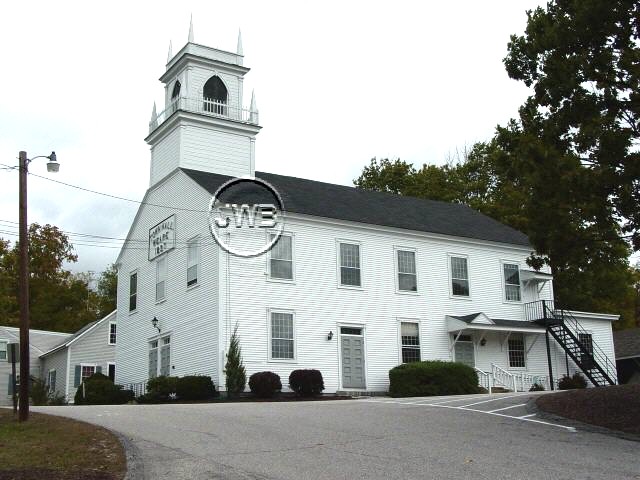
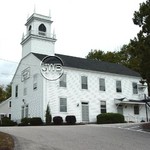
Weare Town Hall, photograph by Janice W. Brown in 2004.
The Boston Tea Party is famous as being one of the earliest ‘patriotic events’ leading up to the American Revolution. Citizens of Weare, New Hampshire rebelled against the King of England some TWENTY months before the Boston Tea Party, and three years before the “Shot Heard Round The World.”
Within the Royal Province of New Hampshire, when grants were written which created new townships, Governor Benning Wentworth included a clause that reserved “all white pine trees” fit for creating masts for the royal navy, to be restricted to the King of England. In 1722 the New Hampshire
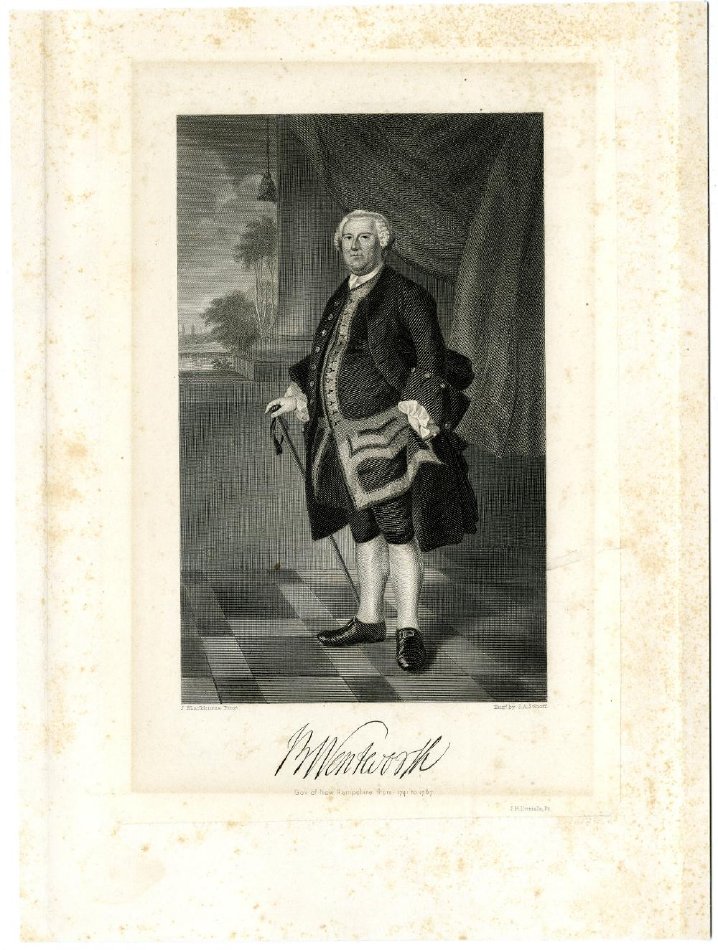
Engraving, portrait of Benning Wentworth (1696-1770). Engraved by Stephen A. Schoff. New Hampshire Historical Society Collection
General Court passed an act (which was enforced until the American Revolution) making it a penal offense to cut any trees that were twelve inches or more in diameter. The fine for doing so was five pounds, and all lumber made from such trees was forfeited to the king.
The New Hampshire colonists were not happy with this law. Weare was an area noted for many large, tall pine trees. Mast Road in neighboring Goffstown, is thusly named because these large trees, which were to be turned into ship’s masts, were hauled down that road on its way to the Amoskeag River in “Squog” or the west side of Manchester, and then rafted down the Merrimack river to Newburyport or Boston. The Weare settlers (along with others in NH) wanted the trees that stood on their land for building their houses, churches, and to sell for profit.

Engraving. Portrait of Governor John Wentworth (1737-1820). Engraved by H. W. Smith. New Hampshire Historical Society Collection
In 1771 Governor John Wentworth was appointed a ‘Surveyor of the King’s Woods’ and he appointed deputies that traveled throughout the state, enforcing the law. They searched saw mills, marked any trees in the mill that should have been reserved for the king with a “broad arrow mark,” confiscating them for sale with the proceeds going into the King’s treasury. Following the posting of an advertisement in the newspaper, if the matter was not settled, the offending saw mill owner and any others involved were arrested, often tried in court, and fined.
As a result, a new settler, before he could build his cabin and clear his land, had to get a deputy to put the broad arrow mark on all the king’s pine trees that were to be kept for masts, and then a royal license to cut the rest, for all which he had to pay a good sum. The settlers of Weare, for the most part, were poor, and so they would circumnavigate this law when they could.
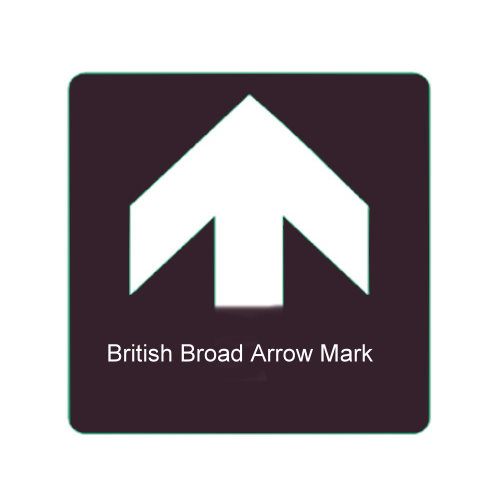
Example of the broad arrow mark that would be slashed into the trees intended for the King’s use.
In 1772, one of these deputies, John Sherburn, visited the area. He he found a large lot ofwhite-pine logs at Richards’, Asa Pattee’s and Dow’s mills; two hundred and seventy logs, that were from 17 to 36 inches in diameter, in Clement’s mill yard, at Oil Mill Village (a section of South Weare, near the Goffstown line), and one hundred and fifty-four at Job Rowles’ mill in Dunbarton. The deputies duly marked the trees, and a made out a warrant against Ebenezer Mudget of Weare, and others who had brought the trees to the lumber mills. An advertisement was placed in the New Hampshire Gazette, Feb. 7, 1772, at Portsmouth, libeling the offenders, and the log-cutters were cited to come in and show cause why these logs should not be forfeited.
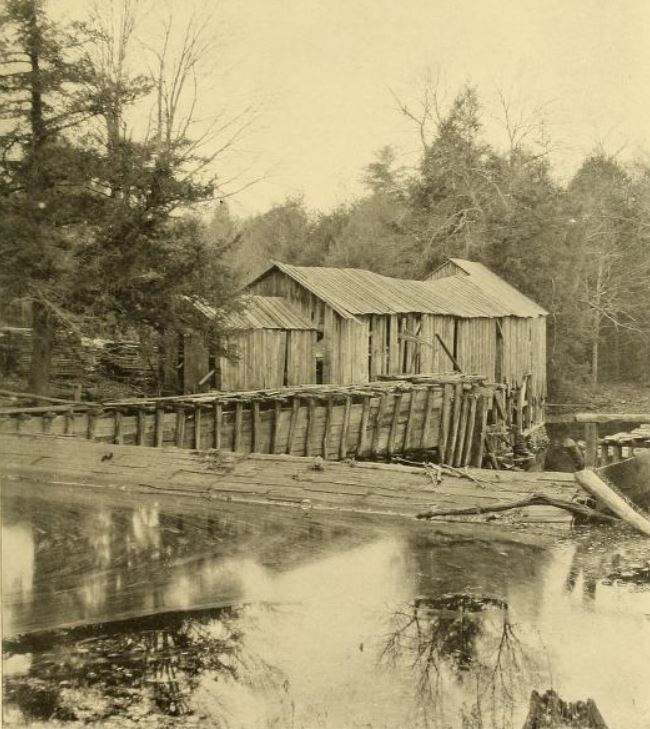
Photograph of the oldest saw mill in New York, from Six Annual Report of the Forest, Fish and Game Commission of the State of New York, 1901, page 354
5 February 1772–Portsmouth.
A citation is published in the New Hampshire Gazette, and read as follows: All persons claiming property in the following WHITE PINE LOGS, seized by order of the SURVEYOR GENERAL in Goffstown and Weare, in the Province of New Hampshire, may appear at Court of Vice Admiralty to be held at Portsmouth, on Thursday the 27th instant at Ten of the clock a.m. and shew cause why the same should not be declared forfeited, agreeable to all information filed in said Court.
200 White Pine Logs from 15 or 30 inches diameter lying at Richard’s mill in Goffstown
250 Ditto from 15 to 13 inches diameter at Patty’s mill.
35 Ditto from 36 to 20 ditto at Dow’s mill.
140 Ditto from 30 to 18 ditto at Asa Patty’s old mill.
270 Ditto from 36 to 17 ditto at Clement’s mill in Weare
154 Ditto from 36 to 15 at Job Rowell’s mill
Also 74 bundles of Clapboards at Merrimack River, Portsmouth, Feb 5, 1772. JOHN SHERBURN, D. Rr.
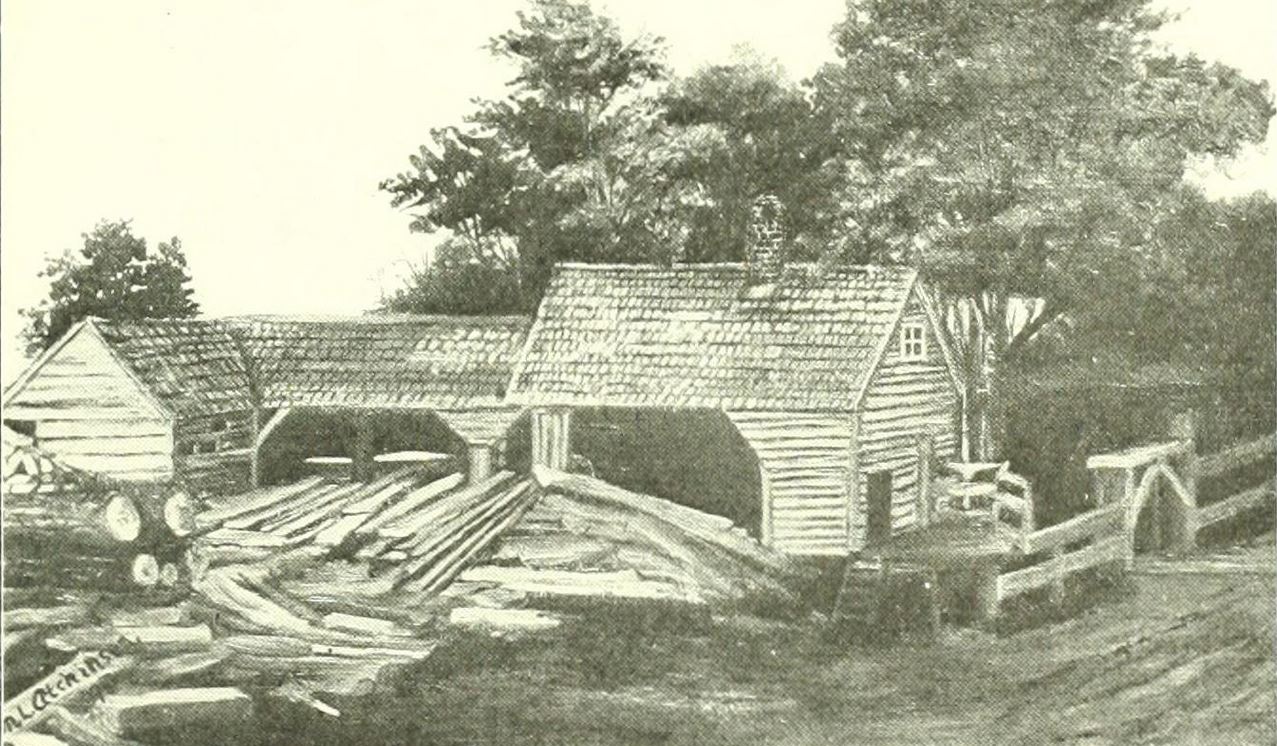
A drawing of the Harris Mill, Ludlow MA, from The History of Ludlow, Massachusetts, 2d ed, published 1912, Springfield MA
Samuel Blodget, Esq. of Goffstown was sent by the mill owners to settle. According to the History of Weare NH, while there, the governor won Mr. Blodget over, and in February 1772, made him a deputy ‘Surveyor of the Kings Woods,” which included a commission and a large territory to look after. He made an agreement with the governor that the men involved would pay a sum, the logs would be given to them, and the case dropped, then Blodget returned home. On February 24, 1767 Mr. Blodget sent a letter to each man involved indicating his new status, and urging them to pay the fines. Three men from Bedford and fourteen from Goffstown came at once, paid the settlement, and obtained their logs.
But the “obstinate” men of Weare did not come.
Benjamin Whiting, Esquire, of Hollis, who was then sheriff of Hillsborough County, and his deputy Mr. John Quigley, Esq. of Francestown, went to Weare to serve the warrant on Ebenezer Mudgett, who was considered the chief of these offenders. He was living on the north road from Clement’s Mill in the Oil Mill section of South Weare. When arrested, it was late in the day, and Mudgett agreed to provide bail in the morning. They allowed Mudgett to go home, while the two law men went to Aaron Quimby’s inn nearby to spend the night.
13 April 1772. News of Mudgett’s arrest spread throughout the town. Many said they would provide bail for him, and they gathered at his house to create a plan. At dawn, Mudgett went to the inn and woke the sheriff, saying his bail was ready. Whiting jumped out of bed, berated Mudgett for coming so early, and started to dress. Suddenly more than twenty men rushed in. Their faces were blackened and they held switches (rods made of green tree limbs) in their hands. Whiting went for his guns but they were taken from him, and the men beat him. These same men also beat his deputy, Mr. Quigley. Later Whiting would say, “They almost killed me.”
When the beating was over, the horses of the sheriff and his deputy were saddled and bridled, but not before their ears, manes and tails were shaved. (This act made the value of the horses worthless). The King’s men were placed on their horses, and sent down the road with the sound of jeers, jokes and shouts in their ears.
Sheriff Whiting quickly sought out Colonel Moore of Bedford and Edward Goldstone Lutwytche of Merrimack [the history of Weare said they also approached John Goffe of Derryfield]. A posse or party of men assembled and with muskets in hand, marched to Weare to find the rioters. But not a soul could be found, as they had fled to the woods. Soon, one of them was captured and jailed, then the rest discovered when they posted bail, and ordered to appear in His Majesty’s Superior Court.
The eight “rioters” from Weare who were brought before the court were: Jotham Tuttle, Timothy Worthley, Jonathan Worthley, Caleb Atwood, William Dustin, Abraham Johnson, William Quimby and Ebenezer Mudgett.
The Superior Court consisted of the Hon. Theodore Atkinson, Esq, Chief Justice and the Honorables Meshech Weare, Leverett Hubbard and William Parker, Esq., Justices.
In September of 1772 they were indicted, and charged with being rioters and disturbers of the peace, and with “making an assault upon the body of Benjamin Whiting, Esq. Sheriff, and that they beat, wounded and evilly mistreated him and other injuries did so that his life was despaired of.” They were also charged with going “against the peace of our Lord the King, his crown and dignity.” The men they were fined twenty shillings with costs, and they went free. Meshech Weare, who gave his name to the town, was one of the judges of the court. The light fines imposed demonstrate that the judges did not approve of the law, probably any better than the men who cut the logs.
Seventeen months later, another group of men, their faces blackened and painted would dump tea into Boston Harbor. Had they perhaps heard of these courageous men of Weare, and followed their lead?
Taxation without representation, the stamp act, the tax on molasses, the law that all exports should be sent to England and that England should furnish all the imports, the attempt to govern by force and the quartering of troops on the people roused the colonists to armed resistance. The Shot Heard Round the World was sounded on April 19, 1775.
There were other early protests and riots that occurred in New Hampshire, including that of the burning in effigy of George Meserve, the tax man of Portsmouth NH… but that is another story.
Janice
*******************
What happened to the men involved in the “Pine Tree Riot” of Weare NH….
THE RIOTERS
– Caleb Atwood, son of John & Abigail (Sanders) Atwood, was b. 28 Dec 1738 in Hampstead, Rockingham Co. NH. He served during the American revolution for 4 months and 24 days in 1776, participating in the Ticonderoga expedition. In 1762 he had married Elizabeth Atwood, and had nine children. He bought 14 Feb 1760 lot sixty, range two from his father John Atwood for forty two Spanish milled dollars. He came to town in the spring of that year, and built his cabin on the side of Mount Dearborn, the highest house in town. He was a prominent man, active in town affairs, and a member of the first church. In his old age he went to live with his son Joshua in Antrim NH, and later in Deering where he died. His descendants resided in various places including Bradford, Newbury, Weare and Newport NH.
– Lieut. William Dustin [Duston], son of Timothy & Lydia (Raymond) Dustin member of the first Committee of Safety in Weare NH, July 1775; hired Ezra Clement (for 3 months) as his replacement in 1776; Went to Ticonderoga for 4 months and 24 days in 1776. He had married Rhoda Pattee in 1761, and he kept a tavern in South Weare. He had 9 children. William came from Chester NH to Weare when he bought, Sept. 20, 1762, the south-east corner of lot twenty-six, range one. Two years after, 1764, he bought ninety acres of lot thirty-seven, range one, from Asa Pattee. He was very poor, and had nothing when he arrived in Weare, except his axe and his jug. He ran in debt for his land, but raised corn enough the first year to pay for it. He built his cabin a few rods north-east of Meadow Brook, opposite the (later) blacksmith shop in South Weare. Afterwards he built a house, where Dearborn’s tavern would later stand. He also served in the French and Indian War. Reportedly he owned a female slave, named Rose, when he came to Weare. She later went to Boston to live. Also reportedly, Mr. Dustin’s wife was considered a witch.
– Abraham Johnson, b. 30 May 1739 in Haverhill MA, married 27 Nov 1759 in Hampstead, Rockingham Co NH to Priscilla (Stevens) Colby, widow of Theophilus Colby. They had 4 children, the last 2 being born in Weare NH. He is said to have lived on lot sixty-four, range two, in a hut by Mount William Pond. He sold to William Hutchins in 1762, moved to lot two, in the gore, and built a house, the second one north of Oil Mill on the east side of the Piscataquog, where he lived many years.
–Ebenezer Mudgett, son of William & Dinah (Davis) Mudgett, signed the Association Test in Weare, June 1776; he hired Daniel Bayley as his replacement (for 5 months) in 1776; Went to Ticonderoga for 4 months and 24 days in 1776. On 13 Dec 1764 he bought of Jeremiah Allen, lot thirty-six range one. Ebenezer came from Hampstead, and was called “merchant.” In 1766 Ebenezer’s house was designated in the town records as the place where preaching would be held. He had married 10 Oct 1752 in Hampstead, Rockingham Co NH to Miriam Johnson. They had 11 children, the first generation descendants of whom resided in Weare NH, and Lamoille Co VT.
–William Quimby, son of William & Martha (Eastman) Quimby, was born 13 June 1749 in Salisbury MA; he signed the Association Test in Weare, June 1776. He had married in 1768 at Hampstead NH to Mehitable Whitaker. He has come from Derryfield NH about 1753. He fished at Amoskeag falls. He built his cabin of logs hewed square, pinned together, ends breaking joints on lot fifty-five, range one, which he bought of Moses Quimby. He lived in town only a few years, then disposed of his property and removed to Sandwich NH. They had four sons. William’s brothers Aaron and Moses also settled in the town of Weare. His brother Aaron Quimby was the owner of the inn where the scene of the “Pine Tree Riot” took place.
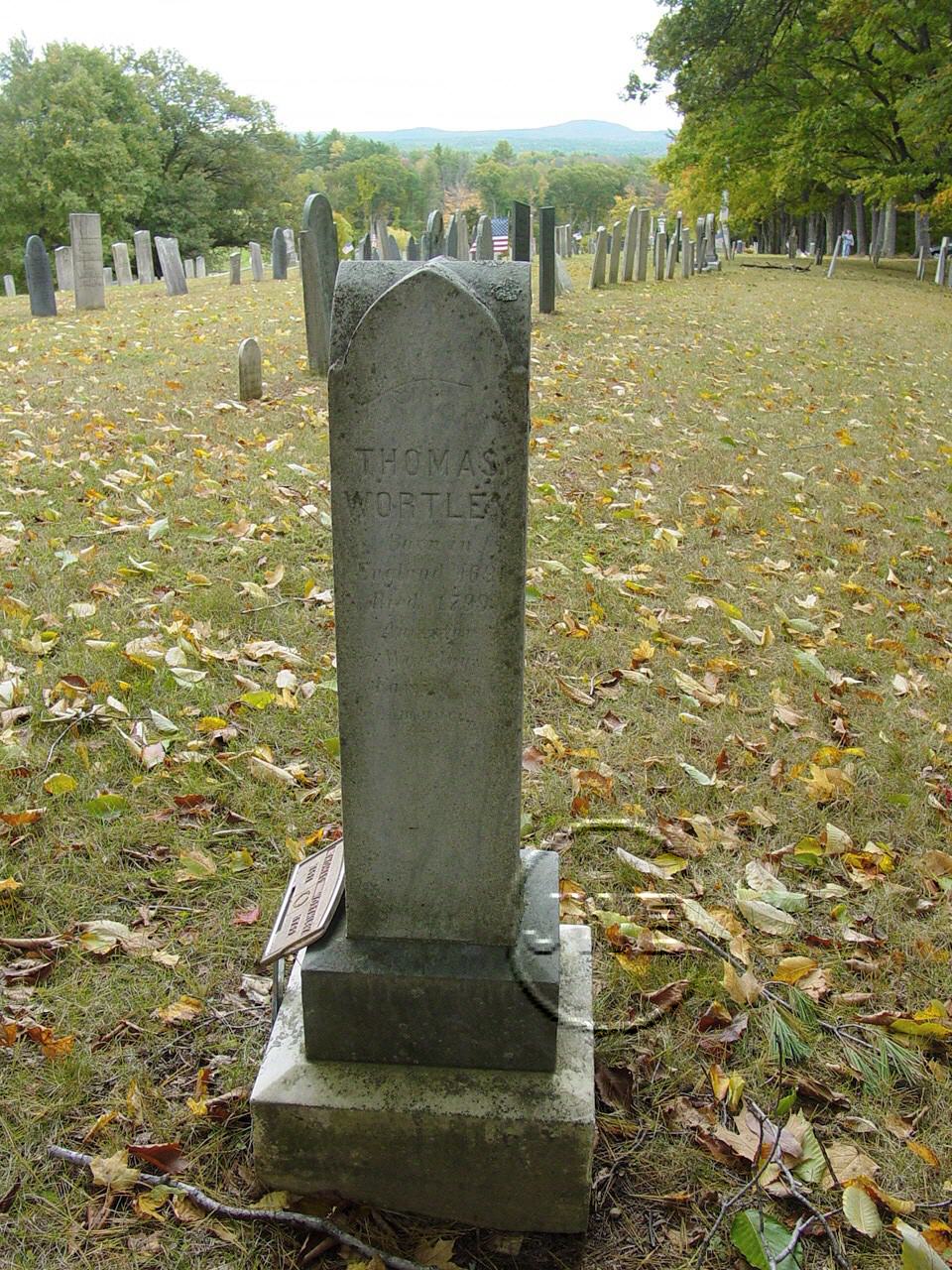
–Jotham Tuttle, son of Jotham & Martha (Hall) Tuttle of Medford MA, signed the Association Test in Weare, June 1776; he came to Weare during the French & Indian War in 1759, and married Molly Worthley (Wortley) daughter of Thomas & Mehitable (Yarrow) Worthley, the second settlers of Weare NH. He was a hunter and fisherman. He was poor, and when he went to Bedford to mill, fourteen miles away, he carried his bag of corn on his shoulder and gun in hand. He would go and return the same day. He had 8 children, whose next generation descendants resided (among other places) in Weare, Goffstown, Amherst, Boscawen NH; Tunbridge, Weston and Sharon, VT. Jotham Tuttle was my 4th great-grandfather. The Timothy and Jonathan Worthley who participated with him, in the Pine Tree Riot, were his wife’s brothers.
–Jonathan Worthley, son of Thomas & Mehitable (Yarrow) Worthley, soldier in the Revolutionary War in Captain John Parker’s Company, Colonel Timothy Bedel’s New Hampshire Regiment of Rangers and was in the Attacks on St. Johns and Fort Chambly in 1775. He was in Captain Aaron Quimby’s Company, Colonel Moses Kelley’s New Hampshire Regiment in the Expedition to Rhode Island under General Sullivan in 1778.enlisted in the army during the American Revolution; State papers show him in Capt. John Parker’s Company, Capt. Timothy Bedell’s regiment, mustered in 11 July 1775, age 23. He married twice, first to Sarah Ordway and second to Mrs. Tamar (Hadley) Grant. He had 14 children by his first wife, whose first generation descendants resided in New Hampshire, Washington County, and Orange Co VT, Gratiot Co, Michigan, and Hancock Co ME.
–Lieut. Timothy Worthley, son of Thomas & Mehitable (Yarrow) Worthley, member of the first Committee of Safety in Weare NH, July 1775; also received lieutenant’s commission during the American Revolution. He married twice, first to Mary Johnson, and 2nd to Lydia Eaton (when he also moved to Goffstown NH). He had 8 children by first wife and 3 by his 2nd. The next generation descendants lived in NH (including Weare, Bedford, New Boston and Antrim), and also New York State.
OTHER WEARE RESIDENTS:
Jonathan Clement – sawmill owner where the logs in question were found. Not specifically named in the warrant against the town. He moved to Weare from Hampstead in April of 1764 when he bought land and the saw mill of Nathaniel Martin in Weare NH and proceeded to build a grist mill. He was a signer of the Association Test in Weare NH. He is Not listed as a direct participant in the Pine Tree Riot. He married Hannah Dustin, and prob 2nd, Sarah Watts. Reportedly had 8 children.
THE KING’S MEN
Samuel Blodget – son of Caleb & Sarah (Wyman) Blodget, b. 1724 in Woburn MA; In 1744-45 participated in Siege of Louisburg; purchased lands in Goffstown NH in 1751; joined the expedition against Crown Point in 1755 and 1757 (under John Goffe), and at seige of Ft. William Henry. In 1765 purchased extensive lands in Goffstown NH (Straw Place); manufactures potash and pearlash, including works in Haverhill MA, Hampstead and New Boston NH; engaged in mercantile business in Boston MA. In 1769 appointed collector of the excise tax by Gov. John Wentworth. In April 1775 opened a store in Goffstown. In June 1775 he was connected with the commisary dept. of the Continental Army, and appointed sutler of Gen. Sullivan’s brigade stationed at Winter Hill. In 1776 he retired from the army and returned to Goffstown where he engaged in mercantile pursuits. In 1777 he offered a bounty of $100 to residents of Goffstown for the growth of wool and flax. In 1780 he was town treasurer and in 1781 one of the selectman. He invented a machine for raising sunken vessel. When 70 years of age he began the construction of the canal and locks on the Amoskeag Canal. At age 83, at the opening of Blodgets lock and canal, rode through the locks and canal on a raft. He died 1 Sep 1807. He m. about 1748 Hannah White of Plaistow NH. He had 10 children. The first generation resided in Amesbury, Haverhill and Boston MA, Philadelphia PA, Goffstown and Manchester (Derryfield) NH.
John Quigley, deputy, was also considered a “Tory” and “had to leave his country for his country’s good.” [Prov. Papers, vol vii, pp. 417, 563, 639]. The History of Weare NH states, “Quigley shrewdly tried to make his peace and become a patriot. He got a part of the committees of three towns to “whitewash” him, and when people persisted in calling him a tory and treating him as such, he got his friends on the committees to send a remonstrance to the congress at Exeter.” Quigley was advised by the committee to enlist in the army, and gave him a letter to Colonel Bedell who was raising a regiment on the frontier of Coos. Whether he enlisted or not is not known.
Benjamin Whiting, son of John & Sarah (Hunt) Whiting, born 15 Feb 1740/41, probably died in Canada. First High Sheriff of Hillsborough County NH (1772-1775), involved in the Pine Tree Riot of Weare NH; was considered a “Tory” in the time of the American Revolution, refusing to sign the Association Test. He is supposed to have left the state of NH in 1777, possibly to Nova Scotia [History of Hillsborough Co., p. 595]. The “History of the NH Sheriff’s Dept” states he fled to England. . He married 9 Sep 1770 in Portsmouth NH to Grace Hall dau of Rev. Willard Hall of Westford MA. They lived in Hollis NH and had at least 4 children: Frances Wentworth, Martha, Grace and Sarah. By the “Act of Banishment” of the NH General Court in November 1778, in his absence he was forbidden to return, and his estate was confiscated (Belknap’s History of NH, p. 381). He left behind his family, and he was assumed to have died within a few years after his leaving, as his wife, Grace Whiting, married 28 May 1782 to Burpee Ames of Hollis NH. They had one child, Burpee Ames. Upon her decease, which occurred shortly after this marriage, Mr. Ames married for his 2d wife, Hannah Cumings, the deserted wife of another Hollis’Tory’, Thomas Cumings.
Colonel John Goffe – head of regiment that marched to Weare; son of John & Hannah (Parish) Goffe, b. 1701 prob Boston MA; d. 1781. He married 16 Oct 1722 in MA to Hannah Griggs of Roxbury MA. He settled at the mouth of Cohos Brook in Londonderry NH, at the outlet of Massabesic Pond (called “Moore’s Village). He built a mill, later the current site of the Wayfarer Inn.
Colonel Edward Goldstone Lutwyche – head of regiment; son of Capt. Lawrence and Sarah (Lindall) Lutwyche, born in 1737 and resided in Merrimack, NH, in the Thornton’s Ferry (formerly Lutwyche’s Ferry) section of town; he was selectman in 1763 In 1780 Matthew Thornton, physician and signer of the Declaration of Independance for NH, purchased the confiscasted estate of “Tory’ Edward Goldstone Lutwyche, including the site of the current Thornton’s Ferry Cemetery. Lutwyche was a well educated man, a lawyer by profession, and a colonel of the 5th NH provincial regiment of militia. He fled to Boston to join General Gage’s army, and fought with him in the American Revolution, leaving his wife behind. Mrs. Lutwyche found that running the Ferry was too much of a hardship and she petitioned the legislature for a release. In 1778 Edward Lutwyche superintended the King’s Brewery at New York, being paid at the rate of 10/day. He married in 1748 to Jane Rapalje. His will was probated 23 January 1816 in Canterbury, England.
THE JUSTICES
Theodore Atkinson, Esq. son of Theodore & Mary Atkinson, (1697-1760) was born in New Castle NH. He attended Harvard College, and he had been a clerk of the Court of Common Pleas in Massachusetts and admitted to the Bar there in 1731. He became the first Chief Justice of NH that had any legal training. He was Colonel of the 1st Regiment OF NH militia with active service during the French & Indian War. He was Collector of Customs, Naval Officer and Sheriff of th Province; In 1741 he was appointed Secretary of the Province. Soon after his return in 1754 as a delegate to the Congress at Albany, he was appointed Chief Justice of NH. In 1732 he married the widow Hannah (Wentworth) Plaisted, widow of Samuel Plaisted, and daughter of Lieut-Gov. John & Sarah (Hunking) Wentworth. Both of their children, Hannah and Theodore, predeceased them. In July of 1775 when ordered to turn over the records of the province to the Revolutionary Government in Exeter he refused, but the documents were confiscated. Oddly he was not named in the 1778 list of Loyalists whose lands the patriots confiscated, even though his close associates suffered that fate. He died in Portsmouth in 1779 leaving the bulk of his estate to his cousin, George King, on the condition that he change his surname to Atkinson. He made donations to the Portsmouth Anglican Church, Harvard College, and Dartmouth College. The town of Atkinson NH was named in his honor.
Honorable Meshech Weare, Esq., Justice. Born 16 Jan 1712 in Hampton Falls, Rockingham Co NH. Graduated in 1735 from Harvard College, minister and justice of the Superior Court. Eventually Chief Justice of the NH Supreme Court. Representative to the General Court 1745-1755. Colonel of the provincial militia. The town of Weare NH was named for him. He was a leader in framing the constitution of NH, adopted 5 Jan 1776 (the first American state to formally do so). He was elected Chairman of the Committee of Safety for NH, and served in this capacity throughout the American Revolution. He was elected as New Hampshire’s first constitutional governor (then known as a ‘president’) in 1784. He married 1st to Elizabeth Shaw, and 2nd to Mehitable Wainwright. He had ten children. The first generation lived in locations such as Hampton Falls, Concord, South Hampton, and other places.
Leverett Hubbard, Esq. Justice, son of Nathaniel & Elizabeth (Tailer-Nelson) Hubbard – of Portsmouth NH; He was born in Rhode Island (one record says Dorchester MA) and educated at Harvard College, receiving honors in 1742. He also studied law in Rhode Island. In 1760 he was appointed Controller of Customers of Portsmouth, and in 1763 appointed Justice of the Superior Court of Judicature for the province of NH. He was associate judge of the supreme court of judicature of the state of NH from 1772 to October of 1785. In 1785 when the State Constitution went into operation, he was not reappointed, which left him in very straitened circumstances, and “his mind became in some measure deranged, a few years before his death.” (Annals of Portsmouth, by Nathaniel Adams, 1825). He married 1) Anne Pierce; and 2nd, Anne Jeffreys. He died 2 January 1793 in Portsmouth NH. No known children.
William Parker, Esq., Justice, son of William & Zerviah (Stanley) Parker, was born in 1703 in Portsmouth NH. He attended public school, apprenticed to his father, and in 1732 was admitted to the bar. He was clerk of the commissioners who settled the boundary line between NH and MA in 1737. He was appointed Register of Probate by Gov. Belcher, afterwards becoming a Judge of Admiralty. From 1765 to 1774 he was a member of the General Assembly, and in August 1771 he was appointed a judge of the Superior Court. Following his removal from the bench, he was confined to his house with gout. In 1763 Harvard College conferred on him the degree of Master of Arts. He married 1st) Elizabeth Grafton; m2nd) Widow Coates. He had 3 children by his first wife. The first generation of his descendants lived in Portsmouth NH and Boston, Massachusetts.
*****