Salisbury New Hampshire Lawyer, Orator, Statesman: Daniel Webster (1782-1852)

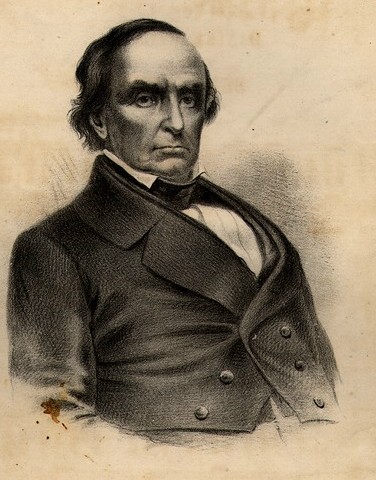
Daniel Webster, son of Ebenezer & Abigail (Eastman) Webster was born in Salisbury, New Hampshire [now Franklin NH] on January 18, 1782, and he died Oct. 24, 1852. He was a statesman, lawyer, and orator.

Likeness of Daniel Webster from front cover from Pamphlet re: Funeral March Performed at the obsequies of the Hon. Daniel Webster. Boston MA: 1871; from American Memory / Rare Book, Manuscript, and Special Collections Library, Duke University at http://tinyurl.com/cypzrfl

Likeness of Daniel Webster from front cover from Pamphlet re: Funeral March Performed at the obsequies of the Hon. Daniel Webster. Boston MA: 1871; from American Memory / Rare Book, Manuscript, and Special Collections Library, Duke University

A farmer’s son, he graduated from Dartmouth College in 1801. In 1805 Webster was accepted into the bar and returned to New Hampshire to set up a practice in Boscawen NH, in part to be near his ailing father. During this time, he took an active interest in politics. After his father’s death in 1806, he handed over his practice to his older brother Ezekiel, who had by this time finished his schooling and been admitted to the bar. Webster then moved to the larger town of Portsmouth in 1807, and opened a practice there. Continue reading

Posted in Genealogy, New Hampshire Men | Tagged , , , , , , , , , , , , | 13 Comments

Crappies and Augurs and Smelt, Oh My!

I sometimes joke that New Hampshire's official state sport should be ice fishing. It is actually skiing. I'm not making fun of ice fishermen and woman.  Anyone who will sit on a frozen lake, staring down at a hole inside a shanty deserves my admiration, as no amount of money would convince me to do it.

I've noticed quite a few “hits” on this blog relating to ice fishing in the past few days.  I'm sure this is due to people looking for Meredith New Hampshire's famous Ice Fishing Derby.  And so this is what you folks are looking for….

Great Rotary Fishing Derby—Meredith, N.H. Feb. 11-12. An estimated 6,000 anglers compete in this statewide tournament featuring $60,000 worth of prizes.
For more information call (603) 279-7600or visit their web site at: http://www.meredithrotary.com.

This year's registration fee is $30. General Information, the registration form, prize list, where to buy a fishing license, where to buy derby tickets, and other information is located on the Meredith NH Rotary web site at http://www.meredithrotary.org/derby/.

Janice
Posted in Current Events | Leave a comment

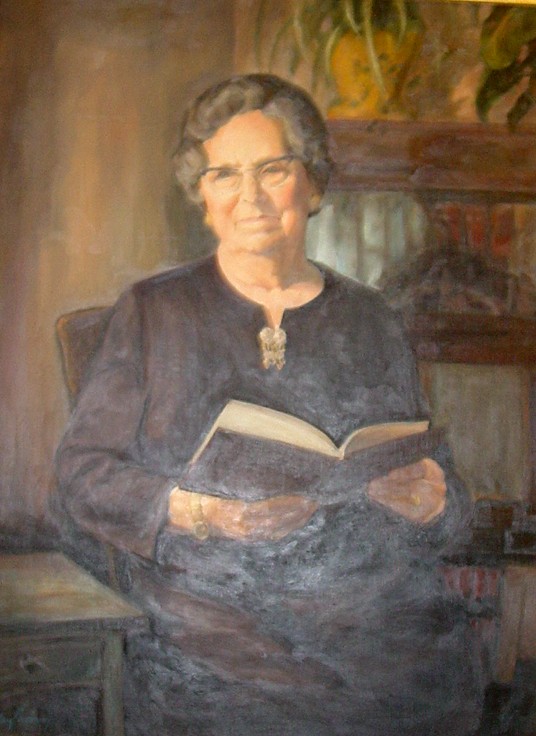
Hilda (Johnson) Brungot


SEE article about Hilda (Johnson) Brungot

Portrait above located in New Hampshire State House, photograph taken by Janice W. Brown.  Portrait by Willy Fromm, 1978.
Presented to the State by friends, 1978.

Posted in History | Tagged , , , | Leave a comment

New Hampshire's Presidential Privacy

To the casual observer genealogists sometimes appear more like “scandal rag” reporters than the serious folks that we are. During these presidential primary months, family tree  researchers were portrayed as myopically focusing on whether the candidates owned slaves, whether they are they related to each other, and if they have connections to famous (or infamous)  people.  

When Damaris Fish of Central Point Oregon sent me an email asking how the presidential candidates stand on issues important to genealogists, I did not have an immediate response.  In my humble opinion a genealogist's greatest need is to have open access to vital records.  Keep in mind that such access used to be governed only by each state's laws, and it was not a matter of national concern (and rightly so).

Damaris asks, “Where is the balance point with access to vital records for historical research, and protecting privacy & identity theft? Have you heard any of the presidential candidates address this issue(s)? How do you allow access to records of interest to family historians, but not compromise privacy of living people?”  

Since I don't have any of the presidential candidates sitting in my living room (although all of them would be welcome) to provide the answers, I decided to look at an event that has shaped privacy policy for the past few years, and will continue to do so for years to come.

Following September 11th it was learned that the terrorists had falsified identification. PLEASE NOTE that all of the Sept 11 hijackers used their REAL names when boarding flights that fatal morning. This knowledge fueled a thoughtless knee-jerk response by legislators and decision-makers, who immediately created and enacted laws that restrict our access to vital records.   

These new laws resulted in making it horrifyingly difficult in some states to obtain or renew driver's licenses and to access vital records. I personally know of a World War II veteran who could produce a pile of paperwork demonstrating that he was alive, had married, had several children, had served in the army, etc. But this same man had spent several months unsuccessfully trying to renew a driver's license because he never had a birth certificate (he was born at home, and the doctor never completed it).

What is mind boggling is that making vital records more difficult to obtain is being touted as a method of preventing the wrong people from obtaining YOUR identification.  One might think that your birth certificate is the primary desire of identity thieves, and that they will use it to spend your money or steal your identity. If you believe this, you are SO WRONG!

The primary (no pun intended) methods of having your identity and/or credit cards stolen, BEFORE and AFTER September 11th are in this order:

1. Auto theft and home break-ins. Do you leave your insurance, driver's license, purse or wallet in your vehicle (on the seat or in the glove compartment)? Is your home burglar proof?

2. Mail skimming and mailbox theft. Someone walks or drives up to your mailbox and takes all or part of the contents. Is your mailbox locked?

3. Telephone scams. Thieves convince you and other people to provide your personal information to them. This is one good reason not to believe anything you hear.

4. Garbage Diving.  Someone sifts through your trash, finding your personal information on forms, receipts, etc.  Woohoo! They might even find a credit card receipt with your signature.

So why are both federal and state governments touting how they are helping us by restricting access to vital records and making drivers licenses harder to obtain? How is this keeping us safe?  Answer: They do it because the government knows it cannot force us to take action to keep our identity safe in the most effective ways.

The government CANNOT force us to:
— keep all personal documents out of our vehicles, install an adequately noisy security system in our homes, or at least buy a little dog that barks when strangers come near  (solving or at least deterring problem #1).
— keep a 24 hour watch on your mailbox, or purchase a locking one (solving #2).

And the government certainly cannot listen in on our telephone conversations (oh wait, maybe they do!) in order to prevent us from sharing confidential information. Passing a law requiring all citizens to shred personal documents before putting them in the trash (solving #4) would actually have a positive impact on the problem, but the odds of such a law being enacted is nil.

And so, instead of focusing on what would actually ease the problem, both state and national  government representatives have turned their attention to what they CAN do, even if it will have no or minimal impact. In the meantime those decisions make research more difficult for over 110 million American genealogists (estimated numbers from 13 years ago!)

The number of existing genealogists (who hopefully all vote) is nothing to sneeze at. An article at genealogy.com states: “According to the poll, approximately 60 percent of the U.S. population is interested in family history, up from 45 percent just five years ago. Beyond that, the poll also showed that about 35 million people have used the Internet for family history research. This means that nearly half of all Internet users have done genealogy online.” 

If there are so many of us, then why aren't we, as genealogists, making more noise in order to obtain better vital record access?  Perhaps this is because we, like the rest of our nation's citizens, are also confused about the causes and cures of identify theft and privacy issues.

And so, when I read that email from Damaris Fish, I decided that the presidential candidates don't talk about “privacy issues” because the term  means something different to each person. The term “privacy issues” encompasses many concerns including: 1) companies sharing your consumer information with others; 2) government surveillance of individuals; 3) the no-call telephone list; 4) keeping health care documents safe; 5) safeguarding our social security number; 6) civil liberties, etc.   Also as I mentioned earlier, the type of privacy that genealogists are mainly interested in, such as making vital record access easier, is still an emotional issue.  The candidates will want to respond to what most people THINK is the problem, not what it actually is.

Before you say, “Wait, you are wrong about the bad guys not wanting my birth certificate,” I'd like you to read two excellent articles about this topic written by my blogger friends Craig Manson and Randy Seaver. You will find the links to those articles below.

And thank you Damaris, for sending the email that gave me a reason to explore the REAL concerns we should have about identity and credit card theft. I took the time to visit several of the presidential candidate's web sites. A few of them mention the topic of privacy, but not a single one of them speaks about the real causes of identity and credit card theft (as outlined above) and none of them indicate that we ourselves have the responsibility and the power to prevent it from happening.  Perhaps we don't want to believe we have that power. Maybe what we really want instead is for our next President to solve that and all our other life problems for us.

Be advised that when I vote, it is irrelevant that Hillary Clinton's family came from the same part of England as George Washington, and that Mike Huckabee is a distant cousin to Amelia Earhart. It will not matter a twit to me whether Barack Obama's ancestors owned slaves, or how Mitt Romney's ancestors worshiped. 

What genealogy has taught me is that I can be (and am) a distant cousin to President George Bush (and a lot of other people) but I do not necessarily share his or their views and personal traits.  The same goes for everyone else.

Janice

Patriotism is supporting your country all the time, and your

government when it deserves it.” –Samuel Langhorne Clemens (Mark Twain)

*Additional Important Reading*

-Craig Manson at GeneaBlogie: Privacy, Public Records, and Genealogy-

-Randy Seaver at Genea-Musings: Identity Theft and Privacy Concerns

Take the Genealogue poll (How Popular is Genealogy?)

Note: as mentioned in my list of 2008 resolutions, this article is the first of more “political” articles that I need to write this year.

Also see.

Miriam Midkiff at AnceStories: “Privacy, Open Access to Records, and Politics.”

Tom MacEntee at Destination Austin Family: “I Want To See Living People; I Want To See Dead People.”

Posted in Current Events, Genealogy | 1 Comment

New Hampshire Glossary: Bannock

Bannock  is a simple or quick- bread cooked on a hearth, or in a frying pan. This type of bread also was easy to make on the trail, when it was rolled into a strip, wound around a green stick and cooked over an open fire.

When cornmeal and an egg were included, it was called a “bannock cake.”  Bannock is a popular foodstuff in Scotland and Ireland, and it is possible this type of bread originated in the British Isles–see origin of the word below.

The history of Wolfeboro New Hampshire (page 537) describes how bannock was prepared: “Thick batter was spread upon a plate or small sheet of iron, sometimes upon a bit of board, and set up edgewise before the kitchen fire. Where the family was large, a considerable number of these would be before the fire at the same time. Rude as the method may seem, it required some skill to properly manage the baking.  Care must be taken that the bread did not burn or slide down on the hearthstone. When one side was sufficiently baked, the bannock must be “turned,” that the other side might be presented to the fire. To do this skillfully was regarded as a very desirable accomplishment.”

Bannock is a great item to make when recreating an American colonial meal, and also as a treat on a camping trip (just remember to bring a large cast iron skillet, the deeper the better).

Janice

Recipe for Bannock

Irish Bannock

Online Etymology Dictionary: bannock

A Tale of A Scottish Bannock

Posted in History, New Hampshire Glossary | Tagged , , , , , , , | Leave a comment