He Taught Henry Ford How To Dance: Swanzey New Hampshire’s Benjamin B. Lovett (1876-1952)

Much is known about Henry Ford–as an inventor, developer of the production line, and history lover. He also was a collector of antique furniture, clocks and violins. What is usually not known about him is that he loved old-time dances. Henry Ford desired intently to bring back the knowledge of dances from his youth–quadrilles, contra dances and round dances.

During his travels Henry Ford found Benjamin B. Lovett and his wife Charlotte who had been teaching “New England social dancing” in Massachusetts for several years. Ford invited the Lovetts to Dearborn, Michigan to help organize dances for the Fords–for his executives and for the Village school students. They did so for twenty years. Continue reading

Posted in Genealogy, New Hampshire Entertainers, New Hampshire Men | Tagged , , , , , , , , , , , , , , , , , , , , , , , | Leave a comment

"Now Is The Winter Of Our Circumvent," by B. Elwin Sherman

First, the term:  “winter driving.”

 
This beggars its own description, because it will never mean the same thing to two people.  First, you must define “winter,” and for some of us this means the end of late summer; for others it's the beginning of early spring.  Then, “driving.”  A wide-open application with so many interpretations, it could easily be called an interpretation with too many applications.
 
Unlike our neighboring state of Massachusetts, there is no such thing as a “typical New Hampshire driver.”  Granite State motorists are a paraphrase of the old changing weather adage:  “If you don’t like the way we’re driving, wait a minute.”
 
That said, there must be some semblance of a winter driving standard to be applied here, so let's just say that the shortest distance between two points is not always a state line.  Maine drivers will know what this means, especially those who live in Massachusetts and sport Vermont license plates (an inside New Hampshire joke).
 
The expression: “You can’t get there from here,” is thought to have originated in Maine.  Not true.  It was first uttered by a New Hampshire motorist (me) who once tried driving from here, (east-west to Maine across New Hampshire's north-south geographical grain) and failed to get there after encountering a highway sign that read:  “Warning: Route 117 Does Not Stop.”
 
Thus, winter driving in New Hampshire is something to be avoided, and this is how Florida was populated.
 
But, however you define it, when vehicular navigation during snow season must be done, there are a few tips:
 
Before going anywhere, check the weather report.  This insures that you'll be stranded in two feet of “passing snow showers,” prompting me to report another pet peeve, when it comes to our softening of the language:  Whatinheck is a “snow shower?”  Is it snowing or raining?  The first time a meteorologist up heah tells me to watch out for blowing “rain drifts,” I'm moving to Orlando, where they know what that means.
 
The New Hampshire Department of Transportation maintains that there is “no technical distinction between a 'road' and a 'highway.'”  We know better.  During a winter storm, if you're driving more than a hoot n' holler but less than a fair piece, you keep to the highway, unless you're headed to Maine and don't care what happens when you can't stop where you can't go.
 
Yes, there's also a difference here, in winter, between a “state” road and a “town” road.  One has potholes full of salt; the other has potholes full of potholes.  We won't even mention “frost heaves,” which deserve not only their own humor column, but another humorist.  I've never found anything funny about broken axles, or having one's upper and lower teeth suddenly inverted, especially when one doesn’t even have dentures.
 
If you're traveling anywhere more than a klick away, (for the military-minded among us), up to and including a hellingone, (for the bumpkins) especially if you eschew the main highway for a back road, you should prepare for a worst case breakdown scenario and bring all the essentials for survival:  blanket, flashlight, cook stove, and a shovel suitable for digging an overnight snow cave.
 
These days, yes, a cell phone would help, unless you're in an unreceptive area.  In this neck of the woods, that's every obstruction between you and this neck of the woods, beginning with that tree your car is leaning against.  But, if you can get your call through, it will also allow you time to snap some keepsake photos of your snow cave during your all-night tow truck vigil.
 
Skidding.
 
Ah, we all remember this mantra from driver's ed class.  Say it with me, all together now: “TURN IN THE DIRECTION OF THE SKID.”   This is supposed to be an instinctive move, like knowing without thinking about the difference between how men and women button.  If you're not reflexively reaching for your buttons right now to quick-see if you're a righty or lefty, then you're wearing a sweater.  And, if you are, you're suddenly unsure, for the first time in your life, which side the buttons are on.  I rest my case.
 
Too late.  While you've been fiddling with your buttons, (often the reason for sliding into a ditch) you've just slid into the ditch, because turning in the direction of the skid has always seemed counter-intuitive to me, unless one is in the grip of a fight-or-flight reaction, where an innate human response directs one to face the danger, in this case, the oncoming neck of the woods.
 
If you do find yourself stuck in the Nor'easter of Route 117, whatever you do, don't try to stop.  When driving in winter, stopping is a dangerous maneuver, and should not be attempted.
 
This means that you've arrived to find yourself sitting in your driveway and not going anywhere.  Don't fret over it.  You could never get anywhere from there, anyway.
 
* * * * *
Syndicated humor columnist B. Elwin Sherman is still not stopping his car in Bethlehem, NH.  He can be reached via his website at: elwinshumor.com.  Copyright 2008 B. Elwin Sherman.  All rights reserved.  Used here with permission.
* * * * *
Posted in Humor, Travel | Tagged , , , , , | Leave a comment

New Hampshire Glossary: Patent Medicine

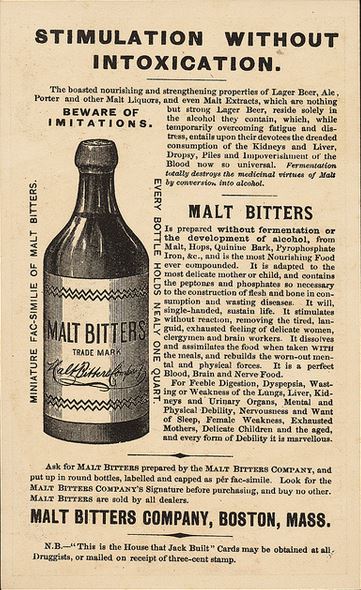
Malt Bitters, 19th Centuery Trade Card, Boston: Forbes Co., Boston Public Library

Malt Bitters, 19th Centuery
Trade Card, Boston: Forbes
Co., Boston Public Library

The definition of patent medicine is a medical compound or mixture of drugs, sometimes called a “nostrum,” that is proprietary, or protected by a patent, and is available without a doctor’s prescription.  In reality, most of the old-time patent medicines were “marked” medicines (usually the container and the label design were trademarked), and the contents were not patented.

Although the term “patent medicine” was first used in the late 17th century in Europe, it  became highly popular in the American colonies. Combinations of herbs and chemicals were branded and sold as cures for every ill.  Some of the more famous “nostrums” that are still well known today are Lydia E. Pinkham’s vegetable compound, and Angostura bitters. Canterbury Shaker Village was well-known in New Hampshire for it’s medicine herb garden used in the creation of herbal and patent medicines.

Patent medicines often made use of grand claims (to cure every known problem), and also first-hand testimonials, which were often promotional statements rather than the actual words of cured customers.Advertising these patent medicines became big business, and reportedly a number of almanacs and newspapers owe their existence to this form of marketing. Some advertisers took to the road with a “medicine show.”

Although I’m sure some of the patent medicines contained ingredients to help ailments internal and external, some of them were either completely ineffective, or were actually dangerous to one’s health.  The makers were not required to list ingredients on the container, nor to provide the information to their customers.  Many of the “medicines” included alcohol, and so they  were the bane of temperance advocates. Others contained drugs such as opium, cocaine, or acetanilide which caused the user to crave more of the remedy.

The Portsmouth Herald of 30 Dec 1901, on page 4 wrote about what they said was the First Patent Medicine as follows: “The first patent medicine, it is asserted, ever put up for sale in America was a proposed cure for consumption. It was called Tuscarora rice and was compounded and sold by a Mrs. Masters, who erected a large establishment for its manufacture in New Jersey about 1711.”

In 1906 the first Pure Food and Drug Act was passed which required these medicines to be labeled, and helped to stop some of the more outrageous medical claims.

Janice

*Additional Reading*

The So-Called “Patent-Medicine” Evil

Patent medicine bottles

History of the Comstock Patent Medicine Business and Dr. Morse’s Indian Root Pills

[Created January 27, 2008, links updated October 10, 2014]

Posted in New Hampshire Glossary | Tagged , , , , , , , , , , , | 1 Comment

New Hampshire: Learn How To Sugar A Maple

Did you ever want to learn how maple syrup is produced?

Don't delay because spaces for some unique courses are filling up quickly.  Construction of the new Remick Museum Sugar House in Tamworth, New Hampshire is almost complete. John Dyrenforth, Remick Museum Trustee and long-time maple producer, will offer a series of workshops to aspiring maple producers in exchange for volunteer work in the Remick Farm sugar bush and sugar house.
 
The Workshops will run for three consecutive Saturdays:
 
February 16, 2008
1oam- 12 noon
Tapping, Tubing & Buckets.
In the classroom, get information on proper tapping procedures, then snowshoe out to the sugar bush to tap trees. Take along a hammer, snowshoes, 18V cordless drill, batteries, and a 5/16 drill bit.
 
February 23, 2008
10am -12 noon
Gathering Sap.
Learn how to hand gather sap and use sap filter. Receive instruction on gathering sap with a gas pump and transferring it to a holding tank. Learn the importance of recording the gallons collected.
 
March 1, 2008
10am- 4pm
Boiling Down, Filtering & Canning.
Learn to boil sap to syrup, and learn the importance of recording the amount of syrup produced. Good heavy duty work gloves are needed to protect from heat.

If you always wanted to learn the maple sugaring process, consider joining the volunteer group. Be one of the first to use the new sugar house! Call Susan Junkins, Volunteer Coordinator, at the Museum at (603) 323-7591 or (800) 686- 6117, for more information or to register. Your volunteer work will support the Remick Museum in its effort to preserve the agricultural way of life in New Hampshire. See you in the sugar bush!

Janice

Posted in Current Events | Leave a comment

Manchester New Hampshire’s Stockbroker and Philanthropist: Henry Melville Fuller (1914-2001)

When Henry Melville Fuller died in 2001,

Photograph of Henry Melville Fuller

Photograph of Henry Melville Fuller

he left funds to benefit several nonprofit agencies, including $43 million and a collection of 19th century American paintings worth $2.6 million to Manchester’s Currier Art Gallery. This was the largest gift to a non-profit in New Hampshire history.

Henry Fuller also endowed the Manchester Historic Association with a $4 million bequest. There were additional beneficiaries (such as Trinity College) that received greater or lesser amounts. Continue reading

Posted in Genealogy, New Hampshire Men | Tagged , , , , , , , , , , | 3 Comments