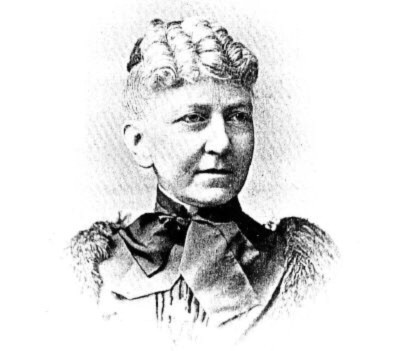
Poem: "The Angel of Discontent," by Sam Walter Foss

When the world was formed and the morning stars
Upon their paths were sent,
The loftiest-browed of the angels was made
The Angel of Discontent.

And he dwelt with man in the caves of the hills,
Where the crested serpent stings
And the tiger tears and the she-wolf howls,–
And he told of better things.

And he led man forth to the towered town,
And forth to the fields of corn;
And told of the ampler work ahead
For which his race was born.

And he whispers to men of those hills he sees
In the blush of the misty west;
And they look to the heights of his lifted eye–
And they hate the name of rest.

In the light of that eye does the slave behold
A hope that is high and brave;
And the madness of war comes into his blood–
For he knows himself a slave.

The serfs of wrong by the light of that eye
March with victorious songs;
For the strength of the right comes into their hearts
When they behold their wrongs.

‘Tis by the light of that lifted eye
That Error’s mists are rent:
A guide to the table-lands of Truth
Is the Angel of Discontent

And still he looks with his lifted eye,
And his glance is far away.
On a light that shines on the glimmering hills
Of a diviner day.

Learn more about the poet, Sam Walter Foss.

Source: Cornell University Library.
Posted in Poetry | Tagged , , , , , , | Leave a comment

New Hampshire Glossary: Soapstone

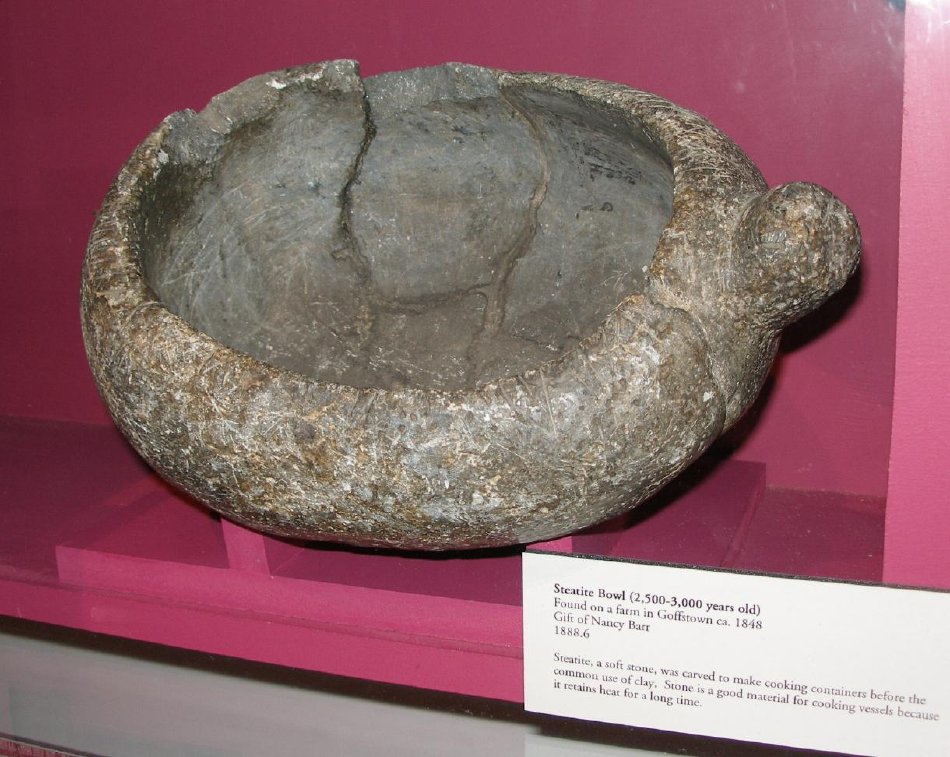
Soapstone bowl found on a farm in Goffstown c1848. Gift of Nancy Barr, Manchester NH 1888; New Hampshire Historical Society Collection

A Native American soapstone bowl/kettle found on a farm in Goffstown c1848. Gift of Nancy Barr, Manchester NH 1888; New Hampshire Historical Society Collection

Soapstone is a metamorphic rock, usually called Steatite by mineralogists, that formed from 300 to 400 million years ago under intense heat and pressure. Because of its ability to be cut or carved easily, from ancient times this stone was used to create sculptures. Due to its tendency to both resist and retain heat, it has often been used for cooking, heating and serving food. Continue reading →

Posted in N.H. Historical Markers, New Hampshire Glossary | Tagged , , , , , , , , , , , , , , | 2 Comments

Portsmouth New Hampshire Poet and Hospital Benefactor, Harriet McEwen Kimball (1834-1917)

Harriet McEwen Kimball was born in Portsmouth, New Hampshire on 2 November 1834.

She was the daughter of a chemist, David Kimball.  Her mother, Caroline, a woman of “unusual attainments,” helped to develop her appreciation for literature. She demonstrated an early talent for writing poetry, and her first volume of poems, “Hymns,” was published in 1867; “Swallow-Flights of Song,” in 1874; “The Blessed Company of all Faithful People,” in 1879, and her complete works in 1889.

The New York Times of October 21, 1890 noted that Miss Harriet McEwen Kimball of 4 Austin Street, Portsmouth, NH won the first prize of $100 from the Hospital Saturday and Hospital Sunday Association for composing “the best hymn suitable to be sung in churches and synagogues…”   Through her life, Harriet continued to write poetry.  She was friends with many poets of the time, including John Greenleaf Whittier, who often exchanged letters with her. Continue reading →

Posted in New Hampshire Women, Poetry | Tagged , , , , , , , | 2 Comments

New Hampshire and the Lowest Social Security Number

New Hampshire has the honor of having had a resident that was issued the lowest social security number. The number, 001-01-0001 was given to Grace D. Owen of Concord New Hampshire in 1936.

Originally this number was going to be given to Social Security Board Chairman John G. Winant of New Hampshire as a token of esteem. Once he refused it, the number was instead issued to the first applicant from New Hampshire–this proved to be Grace D. Owen of Concord, New Hampshire, who applied for her number on November 24, 1936. Continue reading →

Posted in History, New Hampshire Women | Tagged , , , , , , , , , , , | 1 Comment

New Hampshire Glossary: Dowser

A dowser is a person who is able to locate water, and sometimes precious metals. On a few documented occasions, dowsers have located wanted criminals and missing objects. Dowsing is accomplished through an intuitive search process.

In some cases devices made of natural wood, or sometimes of metal (called a dowsing rod or wand) is used to facilitate the discovery. When the dowser walks with the device in his or her hands, they feel a tug, pull, drop, tingling, or other sensation when the desired element is beneath them or nearby. A weighted pendulum is also used in a somewhat different manner such as holding it over a map, but to bring about the same outcome of discovery.

Before the Victorian era dowsers and their abilities were sometimes considered practitioners of the art of witchcraft or magic, so the wand or rod they used was called a “witching wand,” or a “divining wand.”  Sometimes the wand was crafted from wood of the witch hazel tree. I have seen modern day rods made of metal.

Dowsing is said to have been mentioned in texts prior to 1518 when reportedly it can be found in the writings of Martin Luther (when he condemns its use), and it may have been used earlier on continents other than Europe.

My thanks to Kurious Kitty’s Kurio Kabinet for the inspiration, and for this poem:

Robert Frost Poem, “Two Tramps in Mud Time”
The water for which we may have to look
In summertime with a witching wand,
In every wheelrut’s now a brook,
In every print of a hoof a pond.
Be glad of water, but don’t forget
The lurking frost in the earth beneath
That will steal forth after the sun is set
And show on the water its crystal teeth.

Janice

*Additional Reading*

–American Society of Dowsers–

–Wikipedia: Dowsing (With Photograph)–

–The Divining Rod, A History of Water Witching–

Posted in New Hampshire Glossary | Tagged , , , , , | Leave a comment