Including young people in the celebration of National Poetry Week in New Hampshire may be a good idea… it seems that they need a bit of inspiration… and education.
According to the Associated Press, most New Hampshire pupils are meeting grade-level expectations for proficiency in reading and math, but only half meet that standard for writing, according to the results of new assessment tests.
*****
New Hampshire Happenings
*****
Amy Kane of Atlantic Ave. reports that the North Hampton Library invites you to share your poetry tonight (Monday, April 10) at 7 PM.
Are you a closet poet? Vicky Shouldis of Area 603 invites you to create your own haiku (providing brief instructions).
For high school students without writing talent, you may be interested in the Poetry Outloud Contest. The New Hampshire Final competition has been scheduled and is open to the public: 7pm in Representatives Hall of the State House in Concord on April 10, 2006.
April 24, 2006 – Reading by former U.S. Poet Laureate Billy Collins
Poetry and Politics: Nations of the Mind, a weekend-long conference for poets laureate will be held in Manchester, New Hampshire, on April 25 to April 27.
For additional Poetry and writing events happening soon see: The New Hampshire Writer’s Project Calendar
Also check with your local library for events happening in your community.
Each year the Frost Place Conference on Poetry and Teaching brings together classroom teachers and skilled, practicing poets to talk about the art of poetry and how it is best presented in the classroom. This year the event will be held June 26 – 30, 2006.
***********************
Poetry written by New Hampshirites:
***********************
“Mending Wall”by: Robert Frost (1874-1963)
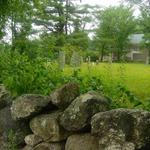
Something there is that doesn’t love a wall,
That sends the frozen-ground-swell under it,
And spills the upper boulders in the sun;
And makes gaps even two can pass abreast.
The work of hunters is another thing:
I have come after them and made repair
Where they have left not one stone on a stone,
But they would have the rabbit out of hiding,
To please the yelping dogs. The gaps I mean,
No one has seen them made or heard them made,
But at spring mending-time we find them there.
I let my neighbor know beyond the hill;
And on a day we meet to walk the line
And set the wall between us once again.
We keep the wall between us as we go.
To each the boulders that have fallen to each.
And some are loaves and some so nearly balls
We have to use a spell to make them balance:
“Stay where you are until our backs are turned!”
We wear our fingers rough with handling them.
Oh, just another kind of out-door game,
One on a side. It comes to little more:
There where it is we do not need the wall:
He is all pine and I am apple orchard.
My apple trees will never get across
And eat the cones under his pines, I tell him.
He only says, “Good fences make good neighbors.”
Spring is the mischief in me, and I wonder
If I could put a notion in his head:
“Why do they make good neighbors? Isn’t it
Where there are cows? But here there are no cows.
Before I built a wall I’d ask to know
What I was walling in or walling out,
And to whom I was like to give offense.
Something there is that doesn’t love a wall,
That wants it down.” I could say “Elves” to him,
But it’s not elves exactly, and I’d rather
He said it for himself. I see him there
Bringing a stone grasped firmly by the top
In each hand, like an old-stone savage armed.
He moves in darkness as it seems to me,
Not of woods only and the shade of trees.
He will not go behind his father’s saying,
And he likes having thought of it so well
He says again, “Good fences make good neighbors.”
*********************************
America
by James Whitfield (1822-1871)
America, it is to thee.
Thou boasted land of liberty,
It is to thee I raise my song,
Thou land of blood, and crime, and wrong,
It is to thee my native land,
From which has issued many a band
To tear the black man from his soil,
And force him here to delve and toil,
. . . Was it for this that wealth and life
Were black and white fought side by side,
Upon the well-contested field, . . .
And made the proud invader yield.
*********************************
IMPRISONED
by: Celia Thaxter (1835-1894)
LIGHTLY she lifts the large, pure, luminous shell,
Poises it in her strong and shapely hand.
“Listen,” she says, “it has a tale to tell,
Spoken in language you may understand.”
Smiling, she holds it at my dreaming ear:
The old, delicious murmur of the sea
Steals like enchantment through me, and I hear
Voices like echoes of eternity.
She stirs it softly. Lo, another speech!
In one of its dim chambers, shut from sight,
Is sealed the water that has kissed the beach
Where the far Indian Ocean leaps in light.
Those laughing ripples, hidden evermore
In utter darkness, plaintively repeat
Their lapsing on the glowing tropic shore
In melancholy whispers low and sweet.
O prisoned wave that may not see the sun!
O voice that never may he comforted!
You cannot break the web that fate has spun;
Out of your world are light and gladness fled.
The red dawn nevermore shall tremble far
Across the leagues of radiant brine to you
You shall not sing to greet the evening star,
Nor dance exulting under heaven’s clear blue.
Inexorably woven is the weft
That shrouds from you all joy but memory;
Only this tender, low lament is left
Of all the sumptuous splendor of the sea.
“Imprisoned” is reprinted from The Atlantic Monthly, vol. 32, issue 189 (July 1873).