For a new resident to be successfully integrated into New Hampshire society,
they must become familiar with the following New Hampshire weather-related terms.
Barometer: your son/nephew/co-worker gave you one a few years ago, that hangs on the living room wall. Having a barometer is a New Hampshire tradition, even if they only look at it twice a year, nod and say “its dropping, thats bad.”
Blizzard: when enough snow falls that your Fish & Game Club meeting is cancelled. This is a good time to make snow angels on the graves of your ancestors, catch a snow flake (or two or three) on your tongue, make hot chocolate, and plan trips to Alaska, where dinosaurs made it warmer.
Chilly: The air temperature is below zero with strongly blowing wind and sleet. The look on your neighbor’s face today, may be mistaken for one of New Hampshire’s slightly scary stares.
Chinook: a dog breed created by a northern New Hampshire guy.
Cold: The temperature is minus 30 degrees with a wind-chill factor of at least 100 degrees below zero (also known as “Geezum Crow, it’s cold!”)
Cold Front: The greeting you get from your wife, if you don’t manage to buy the last generator at the hardware store. This happens after you’ve been without electricity for 2 days, and the prospects of getting the juice back on sometime soon is dim.
Damn cold: The temperature is cold enough that exposed flesh freezes in three minutes. Laundry hung on the clothes line breaks into multiple pieces if struck. Not a good day to stick your tongue to a metal flag pole.
Flooding: according to New Hampshire realtors and hydrologists, this event only happens every 100 years. Don’t worry, be happy, buy near low lying water.
Flurries: called a “white out” or blizzard in any other location, but in New Hampshire is considered very light snow fall. This type of event is a necessary part of New Hampshire life, as without it, residents become storm-deprived, and begin to hallucinate.
Frontal Fog: confusion on the part of New Hampshire elected officials, regarding the difference between their state motto, and a marketing slogan. Most likely to occur in the Concord region.
Freezing: air temperatures when newspaper becomes your best friend (as padding between your two layers of socks, and between your ‘parker’ and your plaid shirt). Who needs all ten fingers anyway?
Meteorology: the science of checking out the weather rock in your back yard. If the rock is wet, it’s raining; if it’s white, its snowing… you get the idea.
Heat: a rare natural event occurring approximately 3 days a year. It is often accompanied by a run on air conditioners, followed a few days later by a glut of “only used once” air conditioner sales on Ebay.
Hypothermia: a rapid lowering of human body temperature, resulting in profound stupidity. Occurs around November, every four years.
Nippy: temperatures well below zero with gale-force winds, and twenty-foot-high snow banks. It is cold enough for the house door to freeze shut.
NOAA: The guy with the long robe who built the big boat, and survived the never-ending showa’.
Radar: an instrument that senses meteorological phenomena. Since this instrument is too expensive, the ‘weather rock’ is more commonly used. See “Meteorology.”
Really Cold: Exposed flesh freezes in ten minutes. Your car won’t start unless you can plug the engine heater in to an electrical outlet a half hour in advance of use. If you don’t have electricity, you are SOL.
Showa‘: a weather event involving water; If you don’t like the weatha’, wait a minute. SEE “NOAA.”
Snow Drift: Accumulation of snow making travel temporarily inconvenient. This problem can be overcome by offering to take the neighbor kids to the mall, if they will remove it from the driverway.
SOL: Sh… errr Simply Out of Luck. A technical term for individuals with weather-related challenges, such as, but not limited to: you can’t find last year’s snow shovels, ice scrapers, can of de-icer, or bag of sidewalk salt. Also an archaic term for the sun (what is that?).
Spring Melt: time to take down the holiday decorations (remove the wooden slats from your boarded up windows). This thaw will be almost immediately followed by a blizzard.
Tempest: a California meteorologist working part-time, who actually thinks he can predict New Hampshire weather.
Too cold to go to the mall: Theoretical temperature used only in scientific hypotheses, because New Hampshire kids will go to the mall, no matter what the temperature is.
Utraviolet radiation: a drill is held, only held in school rooms along New Hampshire’s very short coastline, to prevent exposure to this, in the case of a sudden appearance of SOL [see].
Weather: the state of the atmosphere at a specific place and time. In New Hampshire ‘you can’t get there from here,’ therefore there is no way to know where you are, therefore there is no weather.
Do you have your own New Hampsha’ Weather word(s) to add?
Janice
-Addendum: Also see Raven’s New Hampshire’s Fahrenheit Scale-
-Climate and Weather Terms Glossary (The Real Deal)-
–NOAA–
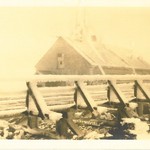
Photograph: the photograph in this article was taken by Berwin Webster in the 1930s or 40s of the Mount Washington Observatory.